Menu

Blog
Why Bag Filters Are Essential for Dust Control in the Steel Industry
Jul 14 2026
Making steel creates a lot of dust. Sounds minor. It isn't. At every stage, from handling raw materials to melting metal to rolling it into shape, tiny particles and metal "fume" (very fine airborne metal bits) fill the air. Some of it you can see. The most harmful part is that you can't, because it's so fine it floats around for ages and slips deep into the lungs when someone breathes it in.
Leave that dust uncontrolled and three things go wrong. Machines wear out. The workplace turns dirty and unhealthy. And the plant lands on the wrong side of pollution law. A bag filter is the main tool plants use to stop all three. This guide explains, in plain language, what a bag filter is, how it works, where it's used in a steel plant, and how to pick and look after a good one.
Quick answer
A bag filter is basically a big box full of fabric bags. Dusty air is pushed through the bags, the dust sticks to the outside, and clean air passes through and leaves. Steel plants rely on them because they catch even the tiniest dust, usually more than 99.9% of it, and they keep doing it reliably. To get a good one, you match the fabric to how hot and how acidic your air is, size it correctly for the amount of dust, and keep the air warm enough that it doesn't go damp inside. Do that and it keeps the plant within pollution limits, and it even saves money by recovering reusable dust.
Where does dust come from in a steel plant
Dust is created at nearly every step of making steel. The most dangerous kind is the super-fine metal dust you can't see, the sort that stays in the air instead of settling.
It starts the moment raw materials are moved. Just tipping and shifting bulk stuff like ore, coal, coke, and lime throws up coarse, gritty dust. Then come the hot stages, and these are the serious ones. When metal is melted, it reacts with oxygen and gives off a very fine metal dust called fume. Tiny. Smaller than you can see. And it's this fume that floats in the air and reaches deep into people's lungs.
Now, here's a point that matters: not all dust is the same. Dust from moving raw materials is heavy and gritty, so it drops fast. Dust from a furnace is the opposite, light and hot and extremely fine, and it can carry metals like zinc and lead if the scrap being melted was coated. Because these two dusts are so different, no single filter bag can handle a whole plant. Hold on to that idea. It shapes every choice that follows.
What a bag filter is and how it works
The short version: dusty air goes through fabric bags, the dust collects on the outside as a layer, clean air passes through, and every so often a puff of compressed air shakes that layer off into a bin below.
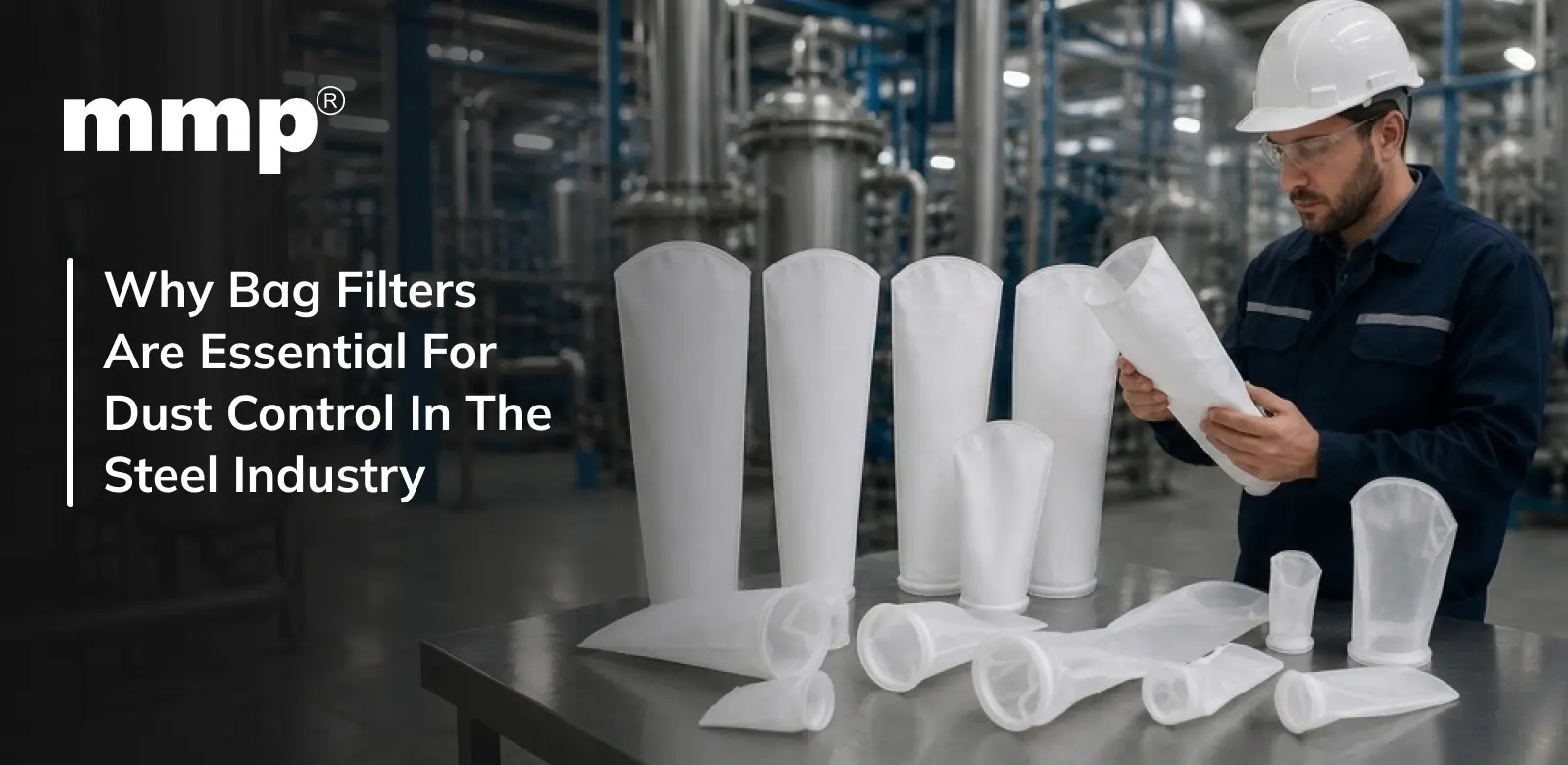
Let's picture it. Dusty air enters a big steel box (called a "baghouse") packed with rows of long fabric bags. Each bag has a wire frame inside holding it open, like a sock stretched over a bottle brush. As air passes through, the dust gets caught on the outside of the fabric while the clean air flows through and out. Funny thing, though: that layer of dust actually helps trap even finer dust, a bit like how an old, clogged coffee filter catches more than a fresh one.
But if the dust layer keeps growing, it eventually blocks the air. So the system cleans itself. A quick blast of compressed air fires into each bag, flexes the fabric, and knocks the dust off. Down it falls into the bin, ready to collect. This happens one row at a time, so the filter never fully stops working. Simple idea. And it scales, from a small unit catching welding smoke right up to a giant system handling the air off an entire furnace.
Learn More: What Is Bag Filter
The main parts of a bag filter system
A bag filter is more than just bags. The full system is the bags, the wire frames that hold them, the plate they hang from, the cleaning system, the collection bin, the fan, and the controls.
| Part | What it does |
|---|---|
| Filter bags | The fabric that traps the dust. The most important part. |
| Support cages | Wire frames inside each bag that stop it collapsing |
| Tube sheet | The plate the bags hang from, keeping dirty and clean air apart |
| Cleaning system | Fires compressed air into the bags to shake the dust off |
| Hopper (bin) | Collects the dust that falls off the bags |
| Housing | The steel box that holds it all and keeps the air paths separate |
| Fan | Pulls the air through the whole system |
| Controls | Watch the system and trigger the cleaning automatically |
One thing worth knowing. The bag and its wire cage work as a team. Even a great bag wears out fast if its cage is bent or rusty, because the fabric rubs against that damaged frame every single time it's cleaned. That's why the people who know what they're doing always order bags and cages together, never separately.
Types of filter bags used in steel plants
The biggest choice is picking a fabric that can survive the heat and the chemicals in your air. Steel plants get very hot, so heat resistance usually decides everything.
This is where the real thinking happens. Use a cheap fabric in a very hot furnace stream and it melts within hours. Use an expensive high-heat fabric on a cool line and you've thrown money away. Match the fabric to the job, though, and it can last for years. Different fabrics handle different temperatures:
| Fabric type | Handles up to (roughly) | Best used for |
|---|---|---|
| Polyester | 130 to 150°C | Cooler areas: moving and crushing raw materials |
| Nomex-type (aramid) | 180 to 200°C | Warm air without strong acids |
| PPS | about 190°C | Furnace exhaust that's hot and acidic |
| P84 | 240 to 260°C | Very hot air needing extra-fine dust capture |
| PTFE | about 260°C | The harshest, most acidic conditions |
| Fibreglass | about 260°C, briefly near 280°C | The hottest air, like from a blast furnace |
And one more thing about steel plants: a standard, off-the-shelf bag often won't fit, because every plant's equipment is built a little differently. This is exactly why suppliers who make custom bag filters to a plant's own measurements are so useful. They avoid the gaps and leaks you get from forcing a "close enough" size. mmp Filtration, for instance, makes its dust collector filter bags, pleated bags, and support cages in-house across this full range of fabrics. So a plant can settle on one agreed design for its steel plant filter bags and buy the lot from a single source, instead of chasing different suppliers for each area. (Quick note to avoid a common mix-up: a liquid bag filter is a totally different product, used to clean liquids, not air. Don't confuse the two.)
Where bag filters are used across steel production
Bag filters show up at almost every dusty point in a steel plant, from the very start with raw materials right through to the finishing stages.
Follow the process and you'll spot them everywhere. When raw materials are crushed and moved, filters grab the gritty dust. At the blast furnace, they handle the hot, heavy dust around the spot where molten metal is tapped out. At the main steelmaking furnaces, they catch the thick fume made when oxygen is blown through the metal, one of the dustiest steps of all. At the electric furnaces that melt scrap, they cope with hot, super-fine fume that often carries zinc. Later steps, like treating the liquid steel and adding alloys, make their own fume. And right at the end, rolling and grinding the steel throws off scale and grinding dust.
Every one of these spots has a different temperature and a different kind of dust, which is why the fabric choice matters so much. The electric furnace is usually the toughest of all. Very hot. Always changing. Full of metals. So it gets the strongest filter bags in the plant.
See Also: Industrial Bag Filter: Working Principle, Design, Components & Uses
Why bag filters beat the other options
Bag filters win because they physically strain out even the tiniest dust, catching more than 99.9% of it, and they do it consistently. The other systems can't match that on the fine metal fume steel plants make.
| Method | How well it catches fine dust | Main weakness |
|---|---|---|
| Cyclone | Poor | Only catches big particles |
| Electrostatic precipitator | Good, but inconsistent | Depends on the dust type |
| Wet scrubber | Medium to good | Creates sludge and rust to manage |
| Bag filter | Very high and steady | Uses more fan power; bags need replacing |
Meeting pollution rules
Steel plants in India have to meet dust limits set by the pollution control boards (CPCB nationally, and the state boards). Bag filters are the standard way to meet them.
Over the years, those limits have got stricter. Many steel processes now have to keep their dust output low, roughly in the region of 30 to 50 milligrams per cubic metre of air, and some are held tighter still. The exact number depends on the specific process and the current rules, so a plant should always check the limit for its own equipment rather than assume one figure. But the trend is clear enough. Limits keep dropping. Checks keep getting stricter.
This is where efficient and reliable dust filter bags become essential, not optional. A well-built system with the right fabric keeps a plant comfortably inside the limit, and the coated bags leave room to spare as rules tighten further. There's a second benefit, too. Catching dust doesn't only clean the air leaving the chimney. It also cuts the loose dust drifting around inside the plant, which keeps workers healthier. So good pollution control filter bags protect a plant two ways at once: the air going out, and the air the workers breathe.
Choosing the right size and type
Start with the air you're cleaning, not with a product catalogue. Before you choose anything, you need to know how much air, how hot, how much dust, how fine, and what chemicals are in it.
Get these basics down first:
- How much air the system must handle, including the busiest times, not just the average.
- How hot the air gets, both normally and at its worst.
- How much dust is in the air, and how fine is it?
- What chemicals are in the air, like acids and moisture?
- The dust limit you have to stay under.
The key sizing decision is how much air each square metre of fabric has to handle. Cram too much air through too little fabric to save money, and the bags wear out fast, dust starts slipping through, and the system clogs. This is the most common way a system is made to look cheap on paper, then performs badly in real life.
Read More: Filter Bags: A Quick Guide to Dust Filtration Solutions
Because getting this match right is so important, it pays to work with a filter bags manufacturer who'll design the fabric and size to your actual conditions instead of just selling you a standard bag. That's the kind of support mmp gives as an industrial bag filter supplier for steel & metal industry needs: matching the fabric, size, and finish to your plant, then supplying that same agreed design every time you reorder, so performance stays steady.
Why bag filters fail, and how to stop it
Almost every failure comes down to one of four things: too much heat, moisture, rubbing, or leaks. And nearly all of them can be prevented.
| Problem | What happens | How to prevent it |
|---|---|---|
| Too much heat | The fabric melts or scorches | Pick a fabric rated above your hottest temperature; add heat alarms |
| Clogging from moisture | Damp dust turns to paste and won't shake off | Keep the air warm and dry; warm the system up before starting |
| Rubbing | The fabric wears through against a damaged frame | Check the wire cages; don't overload the fabric with too much air |
| Chemical damage | Acids eat away the fabric | Match the fabric to the chemicals in the air |
| Burn holes | Sparks from the furnace burn through the bags | Add spark traps before the filter |
| Leaks | A bad seal lets dirty air slip past the bags | Fit the bags properly and check the seals |
Related Articles: Performance Analysis of Filter Bags in Various Industrial Applications
How to look after them
Looking after a bag filter is mostly about watching one reading and acting on it: the pressure difference across the bags. Add regular checks of the cleaning system and the collection bin, and you're most of the way there.
A good routine looks like this:
- Watch the pressure reading over time, not just today's number.
- Check the cleaning system, because weak or damp compressed air ruins the cleaning.
- Keep the compressed air dry, since moisture causes clogging.
- Inspect the bags, cages, and seals during shutdowns.
- Make sure the bin empties properly, so dust doesn't get thrown back into the air.
- Always reorder the same agreed bag design, so behaviour stays predictable.
- When a bag fails early, find out why instead of just replacing it. It's a sign something changed.
Explore More: How to Choose the Best Industrial Bag Filters for Your Factory
What they cost, and what they save
The real payoff isn't only avoiding fines. It's that the dust you catch often has resale or recycling value, and staying within the rules keeps the plant running instead of shut down.
The costs are simple: buying the system, the electricity to run the fan, and replacing the bags now and then. In steel plants, filter bags in steel plants usually last between 18 and 36 months. The harshest furnace areas sit at the shorter end, while cleaner areas and coated bags last longer.
The savings are easy to miss, though. The dust you collect isn't just waste. A lot of it can be fed back into the process, and some furnace dust is rich in zinc, which is worth recovering. Set all that against the cost of a shutdown notice or a fine for breaking the dust limit, and a properly built system usually pays for itself on the rules alone, with the recovered dust as a bonus. The expensive mistake is the opposite one: buying a system that's too small to save money upfront, then paying far more later in worn-out bags, higher power bills, and the risk of breaking the law. Good, high-performance bag filter solutions cost a bit more at the start and much less over the life of the plant.
How to choose a Bag Filter supplier
Judge a supplier on three simple things:
- Can they match the right fabric to your conditions?
- Can they give you the exact same design again and again?
- And do they actually make the bags, or just resell someone else's?
A one-time order is easy for anyone. The real test of a filter bags manufacturer is whether the third and fourth reorders work just as well as the first. If the bags aren't consistent, your dust levels and your replacement timing become a guessing game. So look for a supplier with a real range of fabrics (so they can match your exact conditions), the ability to make custom bag filters to your measurements, and control over their own production so quality stays steady.
mmp Filtration fits that description as an industrial bag filter supplier for the steel industry. It's made air and dust-control filters in-house since 1994, producing its dust collector filter bags, pleated bags, and support cages under one roof, which keeps every reorder consistent. For a steel plant, getting the bags and cages from one maker who understands the whole system, rather than piecing together dust filter bags and filtration solutions from several suppliers, prevents the poor-fit and leak problems that cause early failures. Whichever supplier you look at, ask for the same proof: fabric details, a promise to keep the same design on reorders, and evidence they actually make the product rather than just badge it.