Menu

Blog
Industrial Bag Filter: Working Principle, Design, Components & Uses
Feb 27 2026
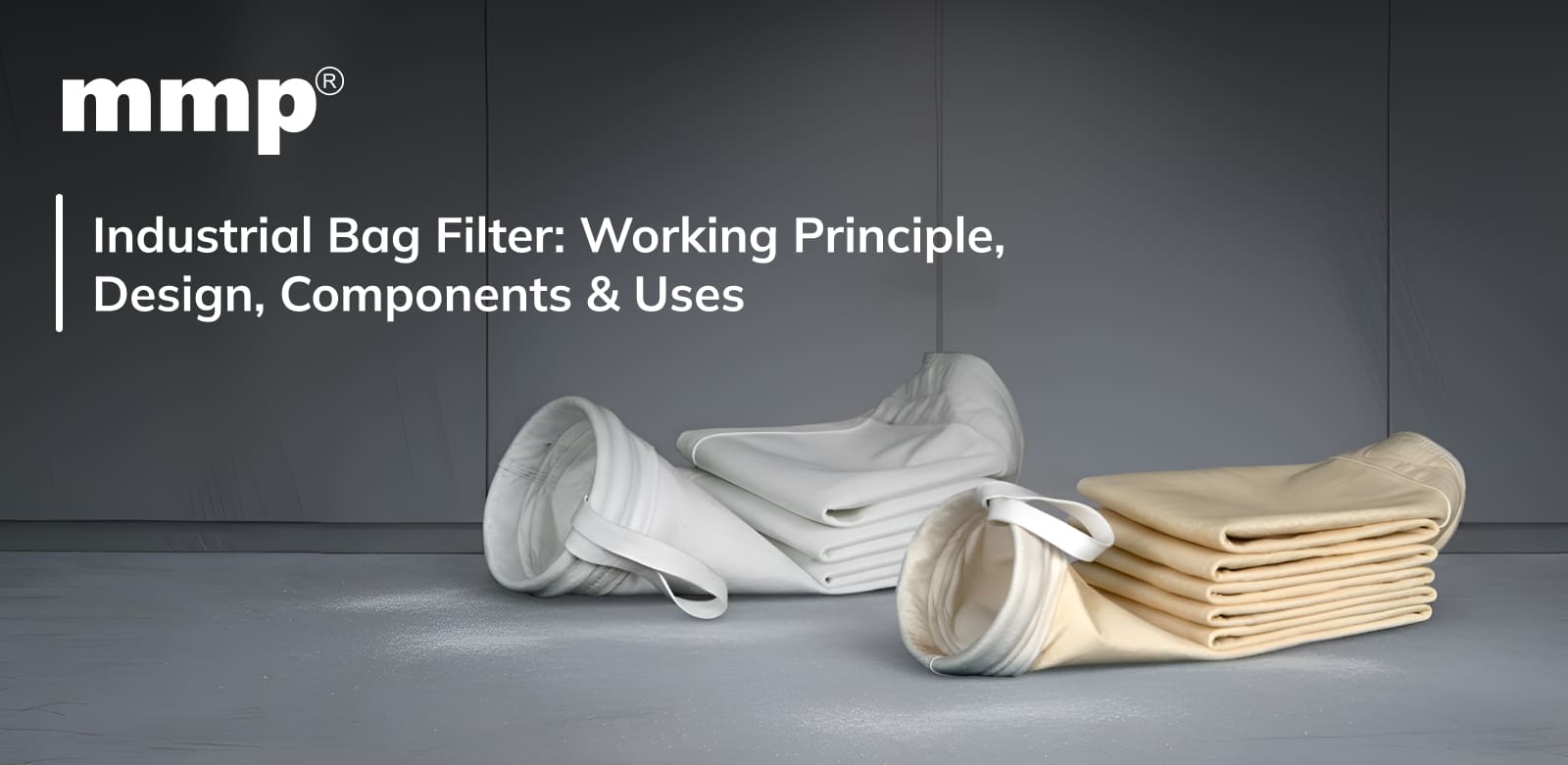
Industrial plants deal with dust every day during crushing, grinding, mixing, conveying, drying, and packing. If this dust is not controlled, it doesn’t just make the shopfloor dirty; it changes airflow balance, reduces capture efficiency at suction points, increases fan and duct wear, and affects the overall stability of the process. This blog explains how an Industrial Bag Filter works in real operating conditions, what design and components decide performance, and why many systems fail due to basic selection or maintenance mistakes. You’ll learn the filtration mechanism, cleaning logic, and how to match bag type and construction to temperature, dust behavior, and chemical exposure. By the end, you’ll be able to evaluate a dust filtration setup as a system, not as a “bag replacement task.”
What is an Industrial Bag Filter?
An Industrial bag filter is a fabric-based filtration arrangement used to capture dust and solid contaminants from air streams. In most industrial setups, dust-laden air is pulled into a collector and directed through a set of filtration bags, where solids are trapped and cleaned air passes through. Over time, dust accumulates on the bag surface and forms a layer that improves fine particle capture, but also increases resistance to airflow. That is why a bag filter is never “install and forget”; it must be cleaned periodically and maintained to keep the pressure drop stable. In a dust collector, the bag assembly becomes the primary media that directly controls emissions performance, airflow stability, and the frequency of bag replacement cycles.
Key points:
- A Bag Filter is designed for continuous duty where dust loading is constant or recurring, not occasional. That means fabric strength, seam integrity, and fit matter over long cycles.
- The Filter Bag does two jobs at once: it blocks particles and maintains permeability for airflow. If permeability collapses (blinding), the extraction airflow drops, and the dust capture at the hoods becomes weak.
- Bag filtration is typically a core element of industrial air pollution control systems, because it is a dry separation method that scales well for high dust loads.
- A bag filter is normally part of a complete Dust Filtration System: hooding + ducting + collector + cleaning + discharge. Performance problems often come from system-level issues, not “bad bags.”
Why Bag Filters Are Important in Industrial Dust Collection
Dust control is not only about a clean plant; it’s about keeping production stable and predictable. When dust escapes capture, it migrates into ducts, settles around equipment, and becomes a secondary source of contamination that keeps re-entering the air. Over time, uncontrolled dust can increase maintenance load on fans and ducting and can create repeated stoppages due to choking, blockages, or housekeeping pressure. Bag filtration is widely used because it can handle mixed particle sizes and high dust loads without requiring water handling or sludge disposal. In industries where processes run 24/7 or in heavy cycles, filtration must be consistent, not perfect on day one, and unstable after two months.
Why bag filtration becomes the practical choice in many plants:
- A bag-based Industrial dust collector setup supports stable capture at multiple pickup points because airflow remains consistent when pressure drop is controlled.
- Dust cake formation improves fine capture without needing complex mechanisms. The system becomes better at retaining fine particulate as it reaches stable operating conditions.
- In India, dust behavior can change with seasons (humidity, monsoon, dry months). Bag filters remain effective when selection considers moisture risk and cleaning tuning.
- Bag filtration fits both emission control and internal air quality goals because it prevents dust recirculation in the plant environment.
Working Principle of Bag Filters
The Bag Filter Working Principle relies on a combination of surface filtration and depth filtration. Dust-laden air enters the collector and moves toward the filter bags. Larger particles typically accumulate on the surface first, while finer particles can lodge into the fibers until a stable dust cake builds. As the cake forms, the filtration efficiency improves because the dust layer itself becomes an additional filtering barrier. The trade-off is pressure drop: the same dust layer that improves capture also increases airflow resistance. That is why cleaning cycles exist to dislodge the dust cake into the hopper and restore permeability so the system can maintain airflow at a workable level.
How the working principle shows up in daily operation:
- In the early stage after new bag installation, fine dust may pass more easily until a dust cake forms; the system typically stabilizes after it “seasons.”
- Cleaning is not meant to fully clean the bag media every time. The goal is controlled cleaning that keeps pressure drop stable while preserving a workable dust cake.
- If cleaning is too weak, dust builds faster than it is released, pressure drop climbs, and airflow at hoods falls, leading to dust escaping into the plant.
- If cleaning is too aggressive, bags experience excess flexing and seam stress, which can reduce life, and fine-capture stability can drop because the cake is removed too completely.
Construction & Design of Bag Filter System
A baghouse is built to manage airflow distribution, filtration, cleaning, and dust discharge as a complete system. Dirty air must enter in a way that distributes the dust load evenly; otherwise, a few bags take most of the load and become blind early. The housing must separate dirty and clean zones so air cannot bypass the media. A hopper must collect the dislodged dust and discharge it reliably; if the hopper is neglected, dust re-enters the airstream and causes unstable pressure drop. Design also includes a serviceability bag, which includes consumables, so the system must allow practical, safe bag changeouts without damaging new bags during installation.
Design considerations that decide performance more than people expect:
- Air distribution and inlet control: Poor distribution leads to localized abrasion and heavy loading on a small section of bags.
- Cleaning system matching: pulse arrangement, valve timing, and pressure must match bag length and collector geometry.
- Hopper evacuation and dust handling: dust must leave the system; otherwise, cleaning just moves dust around inside the collector.
- Access and installation: when access is poor, installation quality drops, and sealing errors cause bypass leakage even with “good bags.”
Main Components of an Industrial Bag Filter
The filtration bag system works because multiple components play specific roles, and failure in one part often looks like “bag failure.” The bag itself retains dust; the cage supports the bag shape; the tube sheet provides the sealing interface between dirty and clean air chambers; the cleaning system removes dust cake; the hopper and discharge remove dust from the system; and instruments like differential pressure measurement help operators keep the system in a stable operating band. When these components are aligned, a baghouse runs predictably; when they are mismatched, you see rapid pressure drop rise, dust leakage, or shortened service life.
Components that must be treated as a matched set:
- Filter Bag: the media that captures particulate; its fabric and finish influence dust release and resistance behavior.
- Dust Collector Filter Cage: supports the bag internally; poor cage finish or wrong fit increases abrasion marks and pinholes.
- Tube sheet and seals: bypass leakage occurs when the sealing is not correct; this causes dust in the clean side, even if the pressure drop seems acceptable.
- Cleaning hardware: valves, manifolds, pulse pipes; cleaning drift creates either blinding (under-cleaning) or fabric fatigue (over-cleaning).
- Hopper and discharge: keeps dust from re-entering; if dust accumulates, cleaning becomes ineffective.
- Controls and monitoring: differential pressure trend is your simplest early warning of system drift.
Types of Bag Filters
“Type” in industrial filtration should be based on what the plant needs to filter and what product category fits that medium. On the dust side, bag filtration is used for Industrial Air Filtration, where air streams carry dust particles. On the liquid side, bag filtration products are used to remove contaminants from fluids and are selected by micron rating and fluid compatibility. Many teams confuse these categories because both are called “filter bags,” but their operating mechanisms and selection logic are different. This section is written to reflect what mmp actually sells, so classification stays product-real and procurement-friendly.
mmp filters supplies bag filtration products mainly across two domains: dust collector baghouse consumables and industrial liquid filtration bags. For dust applications, the focus is on dust collector filter bags, cages, and pleated filter bag replacements that improve filtration surface area in certain collectors. For liquid applications, the product category is Liquid Filter Bags used in fluid filtration lines. This is how you should define the “type” in practical decision-making: dust-side bags for dust collectors versus liquid-side bags for process filtration.
Product types sold by mmp:
- Dust Collector Bag Filter products: dust collector filter bags used in dust collectors/baghouses to capture dry particulate from airflow.
- Dust Collector Filter Cages: cages that support bags and protect them from collapse and uneven stress during operation and cleaning.
- Pleated filter bags: designed as replacements for fabric bags and cages, increasing effective filtration area to improve airflow handling in compact collectors.
- Liquid Filter Bags: industrial filter bags used to remove contaminants from liquids; selected by micron requirement and compatibility rather than dust release behavior.
Applications of Industrial Bag Filters
Bag Filters Applications in Industries depend on where dust is generated and how it behaves. Dust is created during bulk material transfer, grinding, crushing, mixing, drying, and packaging, and these processes typically need continuous dust capture. Cement plants, foundries, power generation, chemicals, pharma, woodworking, and mining all generate different dust profiles. Some are abrasive, some are sticky, some carry moisture risk, and some are fine and difficult to release. Bag filtration remains widely used because it can be adapted through fabric selection, construction, and cleaning tuning to match these varying duty conditions.
How applications shape bag selection in reality:
- Cement and minerals: high dust loads and abrasion; inlet distribution and wear resistance become critical.
- Foundries and metal processes: fine dust and thermal exposure; bag fabric selection and installation discipline matter.
- Power and boiler applications: variable ash characteristics; cleaning stability and pressure drop management decide uptime.
- Chemicals and pharma: fine powders; dust release behavior and sealing discipline become more important than “heavy-duty thickness.”
- Wood and paper: fibrous dust; may require careful cleaning tuning to prevent matting and high pressure drop.
See Also : Pleated Filter Bags for Baghouse Dust Collector
Advantages of Bag Filters
Bag filtration is widely used because it combines strong particulate capture capability with flexibility across different plant conditions. It can manage high dust loads and mixed particle sizes and can operate continuously when cleaning cycles are maintained properly. Bag systems are modular, meaning replacements can be done without redesigning the entire dust collection setup. When fabrics and cleaning are matched, bag filtration can provide predictable pressure drop behavior and stable airflow at pickup points, which directly influences the effectiveness of dust capture throughout the plant.
Practical advantages plants actually feel:
- Stable capture as dust cake forms, improving fine particle retention over time.
- Continuous operation: cleaning cycles allow bags to return to service without stopping production.
- Fabric options allow adaptation across temperature and chemical exposure requirements.
- Modular design allows staged maintenance and replacements without full system overhaul.
- Scalable approach supports different airflow rates and production expansions.
- Plants investing in high-quality bag filtration systems generally see fewer emergencies driven by sudden choking and pressure drop collapse.
Common Problems in Bag Filter Systems
Baghouses are not exposed to ranks but can experience failure in a variety of ways; Baghouses frequently experience bag blinding (clogging and/or air resistance), bypass leakage (air bypass and/or escapes bag), abrasive bag damage (worn rings and/or pinhole), and inferior bag cleaning (dust cake not released from bag). The failure of a baghouse manifests in the following ways: rising differential pressure, reduced pick-up airflow, presence of dust in the clean air plenum, and dust downstream of the baghouse. In many instances, the failure can be attributed to the baghouse being operated out of alignment (baghouse cages), improper sealing at the tube sheet, condensation of moisture, and/or cleaning operation drift, which may have caused the root cause.
Common issues and what they usually mean:
- Rapid pressure drop rise: dust is not releasing often due to moisture/sticky dust, cleaning mismatch, or incorrect fabric selection.
- Dust seen in the clean side: sealing issues or damaged bags; bypass can occur even if the pressure drop appears normal.
- Frequent bag tears: abrasion points from cage issues, inlet velocity hotspots, or installation problems.
- Uneven bag life across compartments: airflow distribution problems and localized overloading.
- Excess compressed air use: over-cleaning and poor tuning; can shorten bag life and increase operating cost.
Maintenance & Troubleshooting Guide
A bag filtration setup stays healthy through routine checks, not crisis replacements. Maintenance should follow the pressure drop trend, inspection observations, and cleaning system verification. Most failures give early signals: pressure drop drift, cleaning frequency changes, dust at inspection doors, or unusual hopper dust behavior. A troubleshooting routine becomes easier when you separate symptoms into categories: airflow collapse, emissions leakage, bag damage, or cleaning inefficiency, and then track each symptom to likely causes. Preventive discipline saves more cost than “buying stronger bags,” because installation quality and cleaning tuning are often the real drivers of lifecycle.
Maintenance practices that consistently improve lifecycle:
- Regular visual inspection of bags for wear rings, seam stress, and pinholes.
- Check cage condition and fit; cage surface finish and alignment reduce abrasion.
- Confirm correct sealing at the tube sheet; bypass is a filtration failure, not a minor leak.
- Verify pulse-jet or cleaning system operation: valve function, timing, pressure, and consistency.
- Manage moisture: condensation leads to mudding and blinding; dew point control matters.
- Track differential pressure; trend-based replacement planning is more stable than waiting for visible emissions.
How to Select the Right Industrial Bag Filter
Selection should be done like process engineering, not like purchasing a “same size replacement.” Start with operating conditions: airflow rate, dust load, dust abrasiveness, dust stickiness, temperature profile, moisture risk, and chemical exposure. Then match the system compatibility: bag dimensions, bag top/bottom construction, and cage fit must align with the collector design to prevent bypass leakage. The final and most important selection layer is fabric: media influences dust capture efficiency, dust release behavior, pressure drop trend, and service life. In India, seasonal humidity swings can significantly change dust adhesion behavior, so worst-case seasonal operation should be considered during selection.
Selection logic that prevents repeat failures:
- Decide medium first: dust-side air and gas filtration vs liquid filtration; the product family differs.
- Confirm fitment: wrong sealing or a mismatch in cage size creates abrasion and bypass issues.
- Choose fabric based on temperature and chemistry; “standard fabric” can fail fast in harsh duty.
- Consider dust behavior: sticky/fine dust needs better dust release, not only “thicker bags.”
- Evaluate supplier capability as a Filter bag manufacturing company, quality control, seam integrity, and dimensional accuracy to determine consistency.
- When you need a supply partner, evaluate the Industrial Bag Filter Manufacturer's capability based on application match, not slogans.
Industrial Standards & Environmental Compliance
Industrial filtration supports compliance when it is stable, documented, and maintained. Compliance is not just a number at the stack; it depends on whether the filtration system is consistently controlling dust across shifting production loads and seasonal conditions. Many compliance failures happen when plants run bags beyond their effective life or when bypass leakage is ignored because the pressure drop “looks okay.” Good compliance discipline includes tracking differential pressure, inspection logs, bag change history, and corrective actions after abnormal events. This becomes especially important for high-dust industries where inspectors and audits focus on control equipment performance and documented maintenance.
Compliance-ready discipline:
- Keep maintenance records and pressure drop trends to show operational control.
- Prioritize sealing integrity and installation quality to prevent bypass emissions.
- Plan inspections around seasonal moisture and dust behavior shifts common in India.
- Treat dust collector health as part of production stability, not a separate “environment task.”
Future Trends in Bag Filter Technology
Bag filtration continues to evolve in practical directions that plants actually value: lower pressure drop, better dust release stability, and higher filtration area in compact equipment. A major shift is the use of pleated replacements in certain collectors where the footprint is limited, and surface area improvement reduces resistance. Plants are also moving toward more condition-based maintenance, where replacement decisions are driven by differential pressure behavior and inspection evidence rather than fixed intervals. The overall trend is not “new technology replacing bags,” but better use of the same core mechanism through improved media designs, smarter cleaning strategies, and better system matching.
What plants are adopting over time:
- Pleated replacements to increase area and reduce pressure drop in space-limited collectors.
- Better focus on dust release behavior and cleaning tuning to reduce chronic blinding.
- More structured inspection routines to prevent bypass and surprise failures.
- Standardization across sites so replacement specs stay consistent and repeatable.
Read More : Bag Filter Types Explained: Uses, Benefits & Applications
Why mmp Filter Bags Are Ideal for Various Industries
At this stage, mmp filters are referenced for contextual accuracy: they operate across both dust-side filtration products and liquid-side filter bag products, which helps plants standardize filtration sourcing across multiple applications. Their dust filtration product set includes dust collector filter bags and supporting cages, plus pleated bag options designed as replacements for traditional bag-and-cage setups. They also supply Liquid Filter Bags, which are a different filtration category used for fluid contaminant removal. For a plant, the practical advantage is procurement clarity: dust collector bags for dust collectors, pleated replacements where needed, and liquid bags for liquid filtration without mixing specifications between unrelated mediums.
How to evaluate them technically:
- As a Filter Bags Manufacturer in India, we evaluate them on consistency of dimensions, seam integrity, and the ability to match OEM collector requirements.
- As an Industrial Filter Bags Manufacturer & Supplier, evaluate fabric range and finishing options based on duty requirements, not a standard-only approach.
- As a Manufacturer of Filter Bags, evaluating repeatability is important because repeatability decides whether performance stays stable across replacement cycles.
- For tough duty conditions, value capability for custom-designed industrial bag filter systems where fitment and application matching reduce bypass and abrasion.
- Use supplier capability to build reliable bag filter solutions across different dust behaviors, seasonal conditions, and plant layouts.
Summary
Bag filtration is effective because it uses a simple mechanism, fabric filtration plus dust cake formation managed through controlled cleaning to keep airflow stable. The system’s real performance depends on fabric selection, correct sealing, cage fit, airflow distribution, and maintenance discipline. When the system is matched correctly to dust behavior and operating conditions, it becomes predictable: stable pressure drop, consistent capture, and planned replacements. When those fundamentals are ignored, plants see the same repeating failures: blinding, bypass leakage, and premature bag damage, no matter how many times bags are replaced. Treat the dust collector as a system, and bag filtration stays reliable for heavy industrial duty.