Menu

Blog
What Is a Baghouse Dust Collector? Working, Types & Industrial Applications
Aug 10 2026
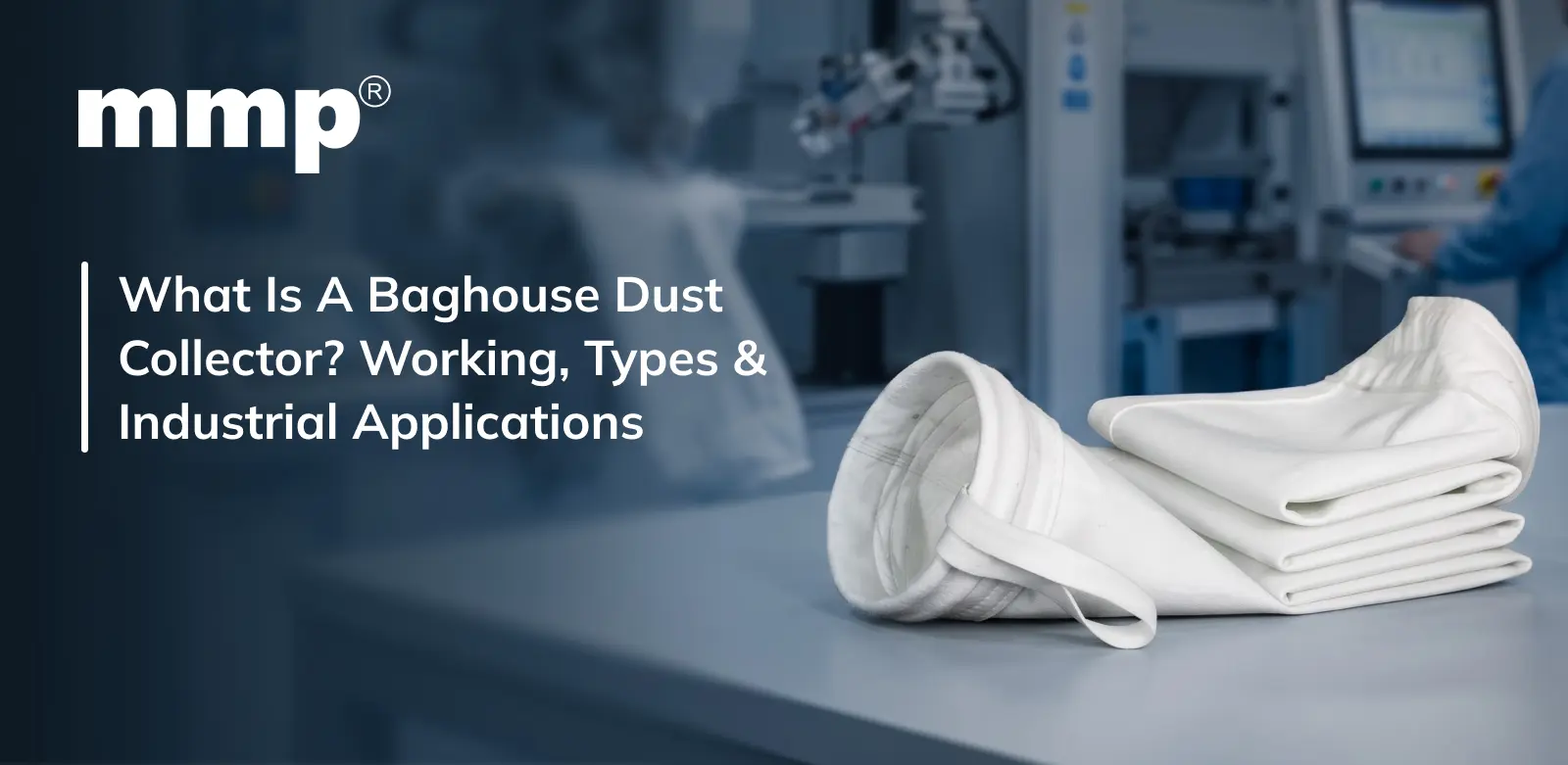
In every industrial setting where materials are processed by cutting, grinding, mixing, or melting of substances, there will be a visible dust plume in the surrounding atmosphere. A bag house dust collector can be defined as a specific equipment used for dust collection processes which prevents airborne dust from damaging workers and their workplace. To put it simply, a baghouse dust collector is a massive filtration system which grabs dirty air, filters out the contaminants through several fabric filters and returns filtered air.
It is a common piece of equipment for air pollution prevention in industry, and its popularity is justified. It is simple, functional and it can remove even the small dust particles that are neglected by other systems. This article will explain what a baghouse machine is, its operating principle, its types, and how to use it properly.
Understanding Baghouse Dust Collectors
A baghouse is a filter system that pulls out fine dust particles from industrial air, which is made using fabric filter bags or pleated filters mounted within a sheet metal housing to remove pollutants or impurities from the air during industrial processes.
What makes it a choice of preference? Is its efficacy on fine dust or something else? A properly operated baghouse captures more than 99% of particles, including very fine ones that pass through cheaper systems, and the level of efficacy is always sustained, without drifting. For this reason, the bag house filter system is extensively used in cement, steel, and food processing sectors, wherever dust is generated in abundance and has to be controlled for safety and emissions purposes.
The main focus of this apparatus is threefold in that it provides protection for workers from inhalation of dust, protects machinery from the effect of dust and meets emissions standards of the plant.
How does a baghouse dust collector work?
The working principle is straightforward, and it runs in a continuous cycle. Here's the sequence:
- Dusty air enters. A fan pulls dust-laden air from the process into the baghouse.
- Dust collects on the bags. The air passes through the fabric bags. Dust is trapped on the outside surface while clean air passes through to the inside.
- A dust cake forms. Within minutes, a thin layer of dust, called the cake, builds on each bag. This cake actually improves filtration, catching finer particles the bare fabric would let through.
- The bags are cleaned. As the cake thickens, it starts to block airflow, so the system cleans itself. A burst of compressed air, or a shake, or reverse airflow (depending on the type) knocks the cake loose.
- Dust drops out. The dislodged dust falls into a hopper below, ready to be collected and removed.
- Clean air exits. The filtered air leaves through the clean-air outlet, and the cycle repeats.
The clever part is that the cleaning happens section by section, so the collector never fully stops filtering. That's how a baghouse dust collector system runs continuously in a plant that operates around the clock, without needing to shut down to clean itself.
Main components of a baghouse dust collector
A baghouse is more than a box of bags. Each part has a job, and the system only works when they work together:
- Filter bags — the fabric tubes that do the actual filtering. The heart of the system.
- Support cages — wire frames inside each bag that hold its shape against the airflow.
- Tube sheet — the plate the bags hang from, separating the dirty-air side from the clean-air side.
- Cleaning mechanism — the compressed-air pulse, shaker, or reverse-air system that removes the dust cake.
- Hopper — the funnel-shaped bin at the bottom that collects the fallen dust.
- Housing — the steel enclosure that holds everything and keeps the air paths separate.
- Fan (blower) — moves the air through the system and overcomes the resistance of the bags.
- Controls — monitor pressure, trigger cleaning, and flag problems automatically.
One pairing is worth understanding: the bag and its cage work as a unit. A good bag on a bent or corroded cage still fails early, because the fabric rubs against the damaged frame every time it's cleaned. Serious buyers order the two matched, which is one reason the quality of the filter bags and their cages matters as much as the collector itself.
Types of baghouse dust collectors
Baghouses are grouped by how they clean the bags. The cleaning method is the main difference, and it decides which duty each type suits.
| Type | How it cleans | Best suited to |
|---|---|---|
| Pulse-jet | A short blast of compressed air fires into each bag, flexing it to shed the cake | Most industrial duties; high dust loads; continuous operation |
| Reverse-air | Gentle reverse airflow collapses the bag to release dust | Large volumes, fragile bags, high-temperature gas |
| Shaker | A mechanical shake dislodges the dust from the bags | Smaller or intermittent operations; lighter dust loads |
Pulse-jet is by far the most common in modern industry. It cleans without stopping the airflow, handles heavy dust, and runs continuously, which is why most new installations use it. Reverse-air is gentler on the bags and suits very large or high-temperature applications like power and steel. Shaker units are simpler and cheaper, and they fit smaller plants or processes that don't run non-stop. Choosing between them comes down to your dust load, how continuously you run, and the gas temperature. For steel manufacturing and high-dust environments, bag filters for dust control in the steel industry can provide effective and reliable filtration when the right baghouse system is selected.
Top applications across industries
Because dust is created almost everywhere in heavy industry, baghouses show up across a huge range of sectors:
- Cement and minerals — controlling the heavy dust from crushing, grinding, and kilns.
- Steel and metals — capturing furnace fume and dust from melting and handling.
- Power generation — collecting fly ash from coal combustion.
- Food and beverage — controlling flour, sugar, starch, and milk-powder dust in dry processing.
- Pharmaceuticals — containing fine powder during mixing, granulation, and packing.
- Woodworking and furniture — collecting sawdust and sanding dust.
- Chemicals and plastics — handling process dust and fine powders.
The common thread is that each of these creates dust in volume, and each has to control it for the same three reasons: worker health, equipment protection, and legal compliance. An industrial baghouse dust collector is the standard answer across all of them, with the filter media and size tuned to the specific dust in each case. For a closer look at how the bags themselves differ by application, mmp’s guide to industrial dust collector filter bags breaks it down further.
Benefits of installing a baghouse dust collector
The reasons to install one go well beyond simply "catching dust." The real benefits stack up across safety, cost, and compliance:
- High efficiency on fine dust — captures over 99% of particulate, including the fine fraction that harms lungs and fouls equipment.
- Consistent performance — filters mechanically, so efficiency stays steady regardless of the dust's electrical properties.
- Cleaner, safer workplace — less airborne dust means healthier workers and lower explosion risk in combustible-dust settings.
- Equipment protection — keeping dust off machinery reduces wear and cuts maintenance.
- Regulatory compliance — brings stack emissions within the limits set by pollution control boards.
- Dust recovery — collected material can often be recycled or resold, turning waste into value.
That last point is easy to overlook. In many plants the recovered dust has genuine worth, whether it's cement kiln dust fed back into the process or metal-rich furnace dust with recovery value. The collector doesn't just remove a cost, it can return one.
How to choose the right baghouse dust collector
Choosing well starts with the dust and the air, not with a catalogue. Get these facts on the table first, and the right unit follows:
- Air volume — how much air needs cleaning, measured at peak, not average.
- Dust type and load — what the dust is, how fine it is, and how much of it there is.
- Temperature — the normal and worst-case gas temperature, which decides the bag fabric.
- Gas chemistry — any acids, moisture, or corrosive content that affects media choice.
- Combustibility — whether the dust is explosive, which brings extra safety design.
- Emission target — the limit you have to meet.
From there, two decisions matter most. The filter media has to match the temperature and chemistry, since running the wrong fabric hot ruins it fast. And the air-to-cloth ratio, meaning how much air each square metre of fabric handles, has to suit the dust load. Push that ratio too high to save on size and you get bleed-through, faster wear, and rising pressure drop. Undersizing to look cheaper on paper is the single most common mistake, and it costs far more later.
Factors to consider before purchasing
Picking the right system on paper is one thing. Buying one that keeps performing, year after year, is another, and that comes down to the supplier and the consumables as much as the collector.
- Filter bag quality and consistency — the bags are the working part and the item you'll reorder for years, so consistent bags matter more than the housing.
- Availability of spares — bags and cages should be easy to source, in the right media, when you need them.
- Compliance support — the supplier should help you meet your specific emission limit, not just sell a box.
- Customisation — few plants fit a standard unit exactly, so the ability to build to your conditions avoids poor fit and bypass.
- Total cost, not just price — factor in fan power, bag life, and downtime, not only the purchase figure.
- Bulk and repeat supply — for the bags especially, a supplier who can hold one spec across repeat orders keeps performance predictable.
The theme running through all of it: the collector is a long-term commitment, and the bags are a recurring one. Choosing a supplier who can deliver consistent baghouse filter bags on repeat, matched to your duty, is what keeps the system reliable long after installation.
Maintenance tips for baghouse dust collectors
A baghouse rewards routine attention and punishes neglect. Most of good maintenance is watching one number and acting on what it tells you:
- Watch the differential pressure. The pressure difference across the bags is your dashboard. A steady reading means balance; a slow climb means clogging; a sudden drop usually means a burst bag letting dust through.
- Keep the compressed air dry. Moisture in the cleaning air causes the dust cake to stick and blind the bags.
- Inspect bags, cages, and seals during shutdowns, and check for wear, holes, or leaks.
- Empty the hopper reliably. A bridged or full hopper throws dust back into the airflow.
- Check the cleaning system — valves, timers, and air pressure, since weak cleaning shortens bag life.
- Investigate early bag failure rather than just swapping the bag, because it's usually a sign something upstream changed.
Do these consistently and bags reach their full life. Skip them and you get creeping pressure drop, higher energy bills, and failures that always seem to arrive at the worst time.
Why choose mmp Filtration for baghouse dust collection?
The real test of a baghouse supplier isn't the first delivery. It's whether the tenth order of bags performs exactly like the first, because that consistency is what keeps a collector reliable over its life.
This is where in-house manufacturing counts. mmp Filtration has produced air and dust-control filtration in-house since 1994, making its dust collector filter bags, pleated bags, and support cages under one roof. That end-to-end control is what holds dimensions and build quality steady from batch to batch, so the bags you reorder next year behave like the ones you fitted this year. With supply reaching markets including the USA, UK, UAE, and Australia, that consistency holds at scale and across regions.
For buyers, the practical value is clear. As experienced baghouse dust collector manufacturers, mmp matches media to your temperature, dust, and chemistry, supplies bags and cages together to avoid the fit problems that cause early failure, and holds one spec across repeat and bulk orders. Sourcing the whole solution from one maker who understands the complete system, rather than piecing it together from separate suppliers, is what removes the compatibility gaps that quietly cause most performance complaints.

Conclusion
Choosing the most appropriate unit appears to be as simple as matching the unit and media with the type of dust, making sure it is of proper size, and selecting the supplier providing regular maintenance. However, one of the most important, yet underrated factors that affect the performance of baghouses is represented by the bags and the supplier delivering them.