Menu

Blog
Sediment Filter Cartridge Guide: Types, Micron Ratings, Applications, Replacement & Maintenance
Aug 20 2026
Wondering why you may be seeing rust in your tap water? Are you seeing sand building up in your reverse osmosis system? Have you noticed equipment malfunctioning two years early? In nine out of ten filtration scenarios, the cause is the dirt entering the water supply. Installing a sediment filter cartridge at the beginning of the process will prevent sand, dirt, silt, and rust from entering your pipes or machines. In this guide, you will learn about the types, mesh filters, volumes, applications, replacements, and maintenance of the filters so that you can select the right choice.
Quick Answer
Start with your water source: borewell, tanker, or municipal. That tells you the micron rating you need. Then match cartridge size to your housing. For RO protection, use 5 micron. For drinking water and food-grade use, choose NSF 61 and 372 certified cartridges made from virgin polypropylene. Replace when pressure drops or flow reduces.
What Is a Sediment Filter Cartridge & How Does It Work?
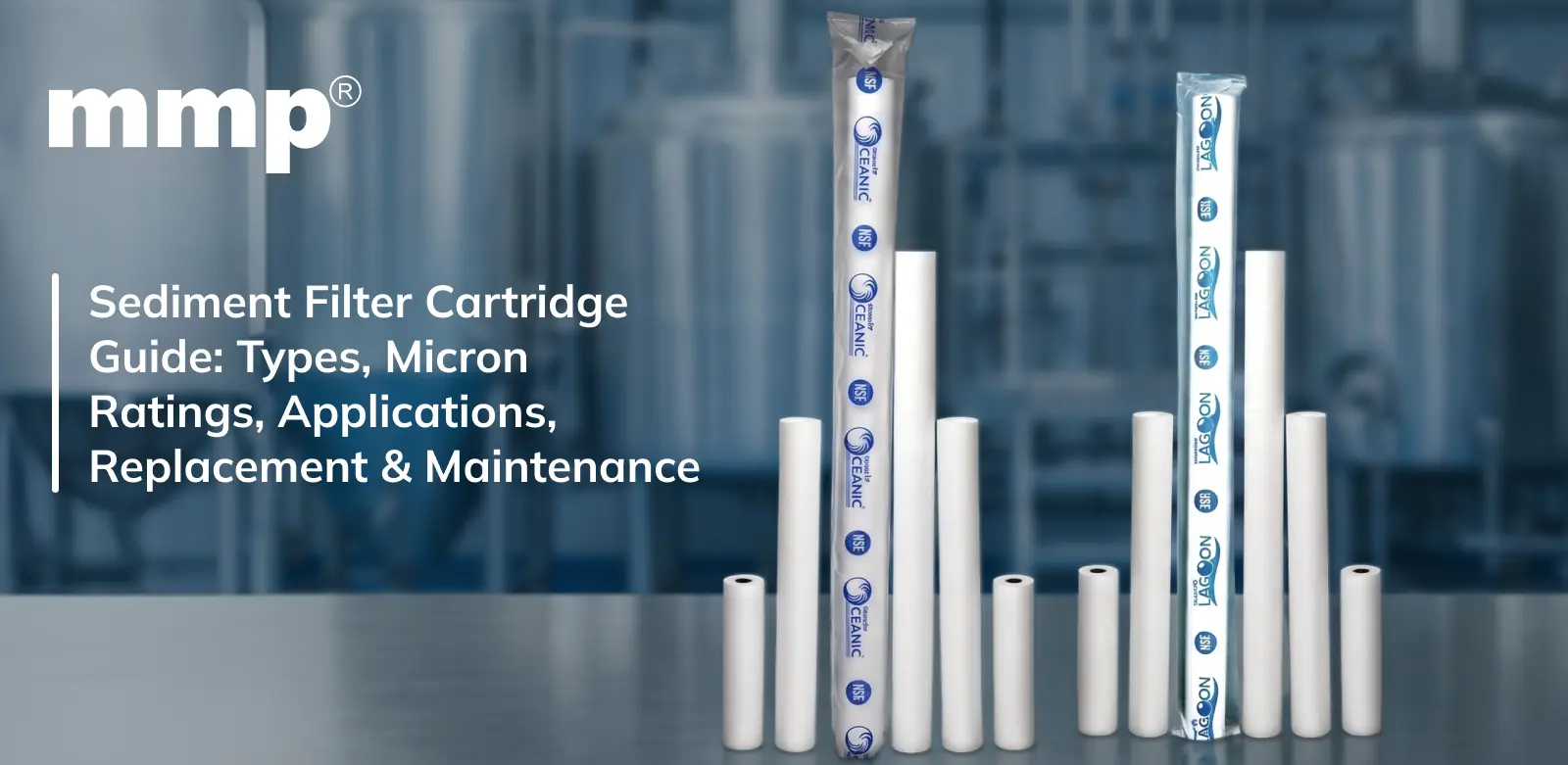
A sediment filter cartridge is a cylindrical filter element installed inside a housing through which your water supply passes. Water enters from outside the cartridge, moves through the filter media, solid particles get trapped, and clean water exits through the centre. No electricity, no chemicals, nothing gets added to the water.
The filtration works in layers. Polypropylene fibres form three gradient density layers, with the outermost layer catching larger particles like sand and grit, and the innermost layer capturing finer particles like silt and fine dust. This depth filtration structure holds a large amount of contamination before performance drops. When the cartridge is fully loaded, water pressure at the outlet falls noticeably compared to the inlet. That pressure difference is your clearest signal that sediment filter cartridge replacement is due.
Types of Sediment Filter Cartridge For Water Filtration
mmp manufactures six types of sediment filter cartridges, each built for specific water conditions. Choosing the right type matters as much as choosing the right micron rating.
- Melt Blown Filter Cartridges — Polypropylene fibres are melted and blown onto a rotating core, forming a gradient density structure that catches sand, silt, clay, and rust. mmp’s Lagoon and Oceanic variants are built specifically for varying contamination loads. Widely used in residential water purifiers and light commercial systems across India and the UAE.
- Wound Filter Cartridges — Yarn wound in a tight diamond pattern around a central core creates filtration channels throughout the full depth of the cartridge. Better suited to borewell and tanker water in states like Rajasthan, Punjab, and Tamil Nadu where sediment loads are inconsistent and often heavy.
- PP Pleated Filter Cartridges — Unlike depth filtration types, this pp sediment filter uses a pleated membrane that dramatically increases filtration surface area inside the same housing size. The result is lower pressure drop, longer service life, and consistent fine particle retention. Standard for RO pre-treatment, pharmaceutical pre-filtration, and food processing. Available in micron ratings from 0.1 to 10 microns.
- PP Spun Filter Cartridges — Built entirely from polypropylene with no adhesives, no binders, and no added chemicals. The correct choice where chemical compatibility of the filter media itself matters alongside sediment removal — pharmaceutical and food-grade applications in particular.
- Resin Bonded Filter Cartridges — Cotton yarn bonded with thermosetting resin gives these cartridges structural rigidity that standard depth filtration types don't have. Used in higher differential pressure applications where the cartridge needs to hold its shape under sustained operating load.
- Grooved Resin Bonded Filter Cartridges — Same resin bonded construction with a grooved outer surface. The grooves increase effective filtration area which extends service life in environments where contamination loads are consistently high.
Micron Ratings: How to Choose the Right One
Micron rating tells you the smallest particle size your sediment filter will reliably capture. Lower number means finer filtration. Higher number means coarser. Both extremes cost money when they're wrong.
For sand, grit, and visible debris in municipal or commercial water supply, 10 to 25 micron handles the job reliably without loading up too fast. Borewell users should start with a 25 to 50 micron first-stage cartridge before a finer one downstream. Putting a fine cartridge directly on heavy sediment exhausts it in weeks and costs far more than running two stages.
RO membrane protection sits at 5 micron. Membranes are expensive to replace and sensitive to particle damage. A 5 micron sediment filter cartridge upstream adds almost no running cost while measurably extending membrane life. Pharmaceutical process water, food-grade filtration, and semiconductor manufacturing require 1 micron or below at the polishing stage. mmp sediment filters cover the full range from 1 to 100 microns across all cartridge types.
What Sizes Do Sediment Filter Cartridges Come In?
Standard sediment filter cartridge lengths are 5 inch, 10 inch, 20 inch, and 30 inch, sized to fit most commercially available filter housings globally. The 10 inch is the standard for single-stage home purifiers and under-counter RO systems. The 20 and 30 inch options are used in commercial setups where higher flow rates and longer service intervals are priorities.
For industrial applications requiring non-standard dimensions, mmp manufactures custom lengths from 5 inch up to 70 inch. Inner diameters range from 27 to 35mm, outer diameters from 50 to 63mm, matched to housing specifications. Pull the existing cartridge before ordering a replacement and confirm the dimensions. A cartridge that doesn't seat correctly in the housing lets water bypass the filter media entirely. The housing will look like it's filtering but it isn't.
Common Applications of Water Sediment Filtration Systems
Water sediment filtration systems are used at every point where untreated water meets equipment or product that needs to stay clean. Here's where they're actually running:
- Residential water purification — First-stage protection for RO and UV systems in homes across Mumbai, Pune, Chennai, Hyderabad, Bangalore, and Ahmedabad. Ageing pipes in these cities push rust and fine debris through municipal supply daily. A filter for sediment at the inlet stops that from reaching membranes and appliances.
- Hotels, hospitals, and commercial buildings — Commercial sediment filters handle large daily water volumes in the UAE, Saudi Arabia, India, and Australia where consistent water quality is both an operational and regulatory requirement. A drop in water quality in a hospital or food service facility isn't just inconvenient; it's a compliance issue.
- Food and beverage manufacturing — Breweries, dairy plants, bottling facilities, and packaged water producers across India, the UK, and Singapore use sediment filtration systems to protect production equipment and meet food safety standards. Sediment in process water affects product quality directly.
- Pharmaceutical and biotech — Pre-filtration of process water and preparation water before reverse osmosis or membrane filtration. Plants in Hyderabad, Pune, and Dubai's pharma free zones rely on fine-rated pp sediment filters at this stage.
- Textile manufacturing — Dyeing units in Surat, Tiruppur, and Ludhiana use industrial sediment filters to keep process water clean enough that sediment doesn't affect dye absorption or final fabric quality.
- Chemical processing — Industrial sediment filters sit upstream of process equipment as pre-filters, protecting pumps, valves, and heat exchangers from particulate wear in chemical plants across Gujarat, Rajasthan, and Abu Dhabi.
- Oil and gas operations — Cooling water and injection water in oil field and refinery operations across the Middle East and offshore India require sediment filtration systems to prevent particulate damage to high-value equipment.
- Water treatment plants — Municipal and industrial water treatment facilities in Delhi, Dubai, Bangalore, and Gujarat use water sediment filtration systems to remove particles before further treatment. A sediment filters for water treatment helps remove sand, silt, and other suspended particles.
How to Choose the Right Sediment Filters
Water source determines everything else. Not price. Not brand. Source.
Borewell water in Gujarat or Rajasthan can contain sand, clay, and sometimes dissolved iron at levels that can exhaust a fine cartridge within weeks. Tanker water is unpredictable, as its quality can vary depending on the source and how long it has been stored. Municipal water from older pipe networks can carry rust and fine silt every day, even when the sediment filter for borewell water plant is operating properly. Each situation requires a different starting micron rating and, in some cases, a different cartridge type.
Once you know your source, match micron to downstream requirements. RO system: 5 micron upstream. Cooling tower or textile process: 25 to 50 micron is sufficient. Pharma or food-grade process water: 1 micron or finer at the polishing stage. Confirm cartridge dimensions match your housing exactly. Check certifications NSF 61 and 372 for drinking water and food contact applications. For industrial sediment filter use, verify temperature tolerance to 60°C and check that the cartridge flow rate matches your operating pressure. Getting these three things right source, micron, housing fit covers most selection errors before they happen.
How Often Do Sediment Filters Need to Be Replaced?
Three to six months is the standard answer. It's also the answer most likely to be wrong for your specific situation.
On clean municipal water in a city apartment with newer plumbing, six months is reasonable. The same cartridge on borewell supply in a rural area with heavy clay and sand content could be fully loaded in five or six weeks. The actual indicator isn't a date — it's pressure. When the water pressure at the outlet drops noticeably compared to what's coming in at the inlet, the cartridge has reached capacity. Visible brown or grey discolouration on the outer surface is the secondary tell that most people notice first.
Commercial sediment filter and industrial sediment filter setups should have pressure gauges fitted on both sides of the housing as a baseline requirement. The differential between inlet and outlet pressure tells you cartridge condition in real numbers rather than guesswork. Track each replacement date and note the condition of the cartridge removed. After two or three cycles at your site, the actual replacement interval becomes clear, and it's site-specific in a way that any published guideline simply can't be.
Sediment Filter Cartridge Maintenance Tips
Good maintenance on a sediment filter cartridge is mostly about not being reactive. By the time you notice a problem, the cartridge has usually been underperforming for a while.
Fit pressure gauges on both sides of the housing if they aren't already there. A few hundred rupees of equipment eliminates the guesswork entirely. Keep a replacement log date in, date out, condition on removal, any change in water quality noticed during that cycle. Two rounds of data and patterns start to emerge that tell you exactly when to order the next batch.
Before opening the housing, always shut off water supply and release system pressure. Skipping this step is how housings crack and cartridges end up on the floor. Once the old cartridge is out, rinse the housing interior with fresh water before installing the new one. Sediment sitting at the bottom of the housing will coat a new cartridge in the first few minutes of operation if you leave it there. PP sediment filter cartridges in pharmaceutical or food-grade environments need a slow flush-through with clean water for a few minutes after installation before the outlet is treated as ready for use.
Why Choose mmp for Sediment Filter For Your Water Filtration
mmp manufactures sediment filter cartridges from Ahmedabad, Gujarat, supplying buyers across India, the USA, UK, UAE, Saudi Arabia, Australia, and Singapore. Residential, commercial sediment filter, and industrial sediment filter requirements are all covered from a single manufacturing source with direct bulk supply and export capability.
mmp uses only virgin polypropylene in its sediment filter construction; there are no binders, adhesives, or surfactants. Our filters are compliant with NSF 61 and 372 standards at last. Commercially, these certifications are one of the requirements for purchasers in North America, Europe, and the Gulf region. From a safety perspective, the certification demonstrates the absence of harmful substances for food and beverage, dairy, and pharmaceutical markets. The product line contains sediment filters with micron ratings from 1 to 100 microns. Our standard lengths suit the majority of common filter housings and even custom lengths of up to 70 inches are available. The company's OEM resellers, distributors, or industrial buyers are provided with perfectly structured products which always meet the original specifications.
Conclusion
Sediment is the most common cause of water system problems across residential, commercial, and industrial setups globally, and a correctly specified sediment filter cartridge is the most cost-effective way to stop it. Match the type to your water source, set the micron rating based on what's downstream, confirm sizing against your housing, and replace based on pressure data rather than a calendar. mmp’s NSF-certified, adhesive-free sediment filters from 1 to 100 microns serve the full range of water sediment filtration systems from a home RO unit in Mumbai to an industrial sediment filtration system running across a manufacturing plant in Dubai or Gujarat.