Menu

Blog
Sediment Filter for Well Water: Types, Micron Ratings, and Uses
Mar 27 2026
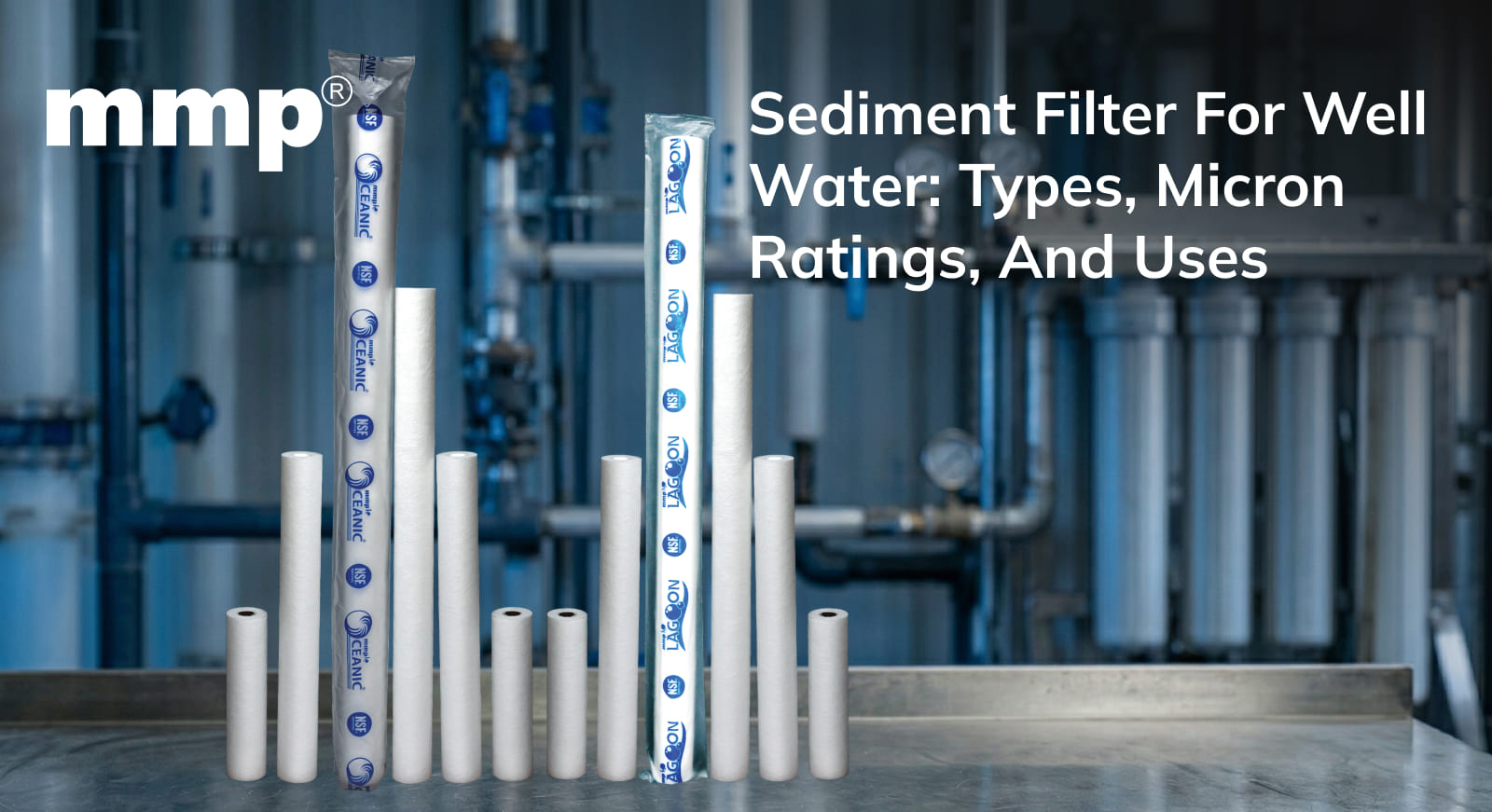
Running a private well is nothing like being on municipal supply, and most people figure that out the hard way. A facility manager dealing with a fouled RO membrane after six months, a housing developer whose tenants are reporting brown water after rainfall, a water treatment contractor whose client keeps burning through pump seals. These are sediment problems. And they are almost always preventable.
No treatment plant is doing pre-work on your behalf. Whatever the groundwater picks up on its way through soil, rock, and old piping arrives at your system exactly as it is. Sand. Rust. Silt. Clay. Fine particles you cannot see until something downstream starts failing.
Sediment filtration fixes this at the source. Get it right and the whole treatment train downstream runs better, lasts longer, and costs less to maintain. This guide is for people who need to make smart buying decisions, not just understand the basics.
What Is a Sediment Filter and How Does It Work?
A sediment filter is a mechanical device. It does one thing: physically block suspended solid particles above a certain size from passing through a water system.
Water enters the housing, moves through a porous filter medium, and exits on the other side. Anything larger than the filter's rated pore size gets caught in the medium. Over time that medium fills up, pressure drop builds, and the cartridge gets replaced.
What separates a good filter for sediment from a poor one comes down to three things: how the filter medium is constructed, how accurately and consistently it holds its rated micron size under real operating pressure, and how much dirt it can hold before it needs changing. These three variables are what actually determine performance in the field, not the spec sheet number alone.
Learn: Sediment Filter: What It Is and Why It’s Important
Why Well Water Demands Dedicated Sediment Filtration
Seasonal ground shifts, heavy rainfall, aging infrastructure. All of it affects what comes out of a private well in ways that change week to week.
After significant rain, disturbed soil near the wellhead releases silt and clay into the supply. Galvanised pipes that have been in the ground for decades shed rust particles continuously. A cracked or deteriorating well casing is basically an open invitation for fine sand. Agricultural zones are their own problem entirely, irrigation activity raises suspended solid concentrations for extended periods, and those peaks hit filtration equipment hard.
Without a working sediment filter for well applications, all of that material moves through the system unchecked. It accumulates inside heat exchangers. It damages pump seals. It pits valve surfaces. It physically blocks the media inside carbon filters and RO membranes, which are far more expensive to replace than a cartridge.
A blocked RO membrane costs several times what a cartridge costs. That alone makes the case for proper pre-filtration in any well-fed system.
The well water sediment filter goes in first. Everything else depends on it doing its job.
mmp Filtration: Product Specs Verified from Source
The specifications referenced throughout this guide come directly from mmp Filtration's product pages, not from general industry figures.
mmp Filtration has operated out of Ahmedabad, Gujarat since 1994. What they do differently from most cartridge suppliers is manufacture everything in-house: PP yarn production, core fabrication, cartridge assembly, and even the winding machines themselves. When a supplier controls every stage of production, quality consistency is traceable in a way it simply cannot be when components come from multiple external vendors.
Their sediment filter cartridge is made from 100% virgin polypropylene using a high-pressure, high-temperature extrusion process on a rotating mandrel. Three gradient filtration layers form during production, coarser at the outer surface, progressively finer toward the core. Available from 5 inches to 70 inches in length. Micron range: 1 to 100µ. Operating temperature: up to 60°C. Flow rate: 1m³ per hour per 10 inch at 2.5 Kg/cm².
The water filter cartridge carries NSF 61 certification confirming materials are safe for potable water contact, and NSF 372 certifying lead-free construction. It is also FDA-compliant and produced without adhesives, binders, or surfactants.
For B2B buyers in pharma, food and beverage processing, or export-facing water treatment projects, those certifications are procurement requirements, not nice-to-haves. Finding a sediment filter supplier that has all of them documented and ready is harder than it sounds.
Types of Sediment Filter Cartridges for Well Water
1. PP Sediment Filter (Gradient Depth Construction)
The PP pleated filter cartridges from mmp is produced by extruding polypropylene fibres through fine holes under high pressure and temperature on a rotating mandrel. Three layers form in the process. The outer layer handles coarser particle capture. Filtration becomes progressively finer moving toward the core. This gradient loading is what gives depth filters their advantage over surface-only designs: particles are distributed across the full thickness of the medium instead of piling up on one layer.
2. Wound Filter Cartridge (String Wound)
mmp winds yarn around a central core in a honeycomb pattern. Tighter winding toward the core creates the same gradient depth structure as the PP sediment filter but through a mechanical winding process rather than extrusion.
The detail that actually matters here: mmp uses Zero Foaming Polypropylene Yarn for their wound cartridges. Foam formation during filtration is a real operational issue, it can bypass filter media and interfere with downstream sensors and process equipment. Eliminating it through the yarn itself rather than through chemical treatment is a more fundamental solution.
Core materials available: polypropylene, stainless steel, tinned steel, wound filter cartridges. Yarn options: PP, polyester, cotton, nylon, rayon, glass fibre. Lengths from 5 to 50 inches. Micron ratings: 0.5, 1, 5, 10, 25, 50, 75, and 100µ nominal.
3. Melt Blown Filter Cartridge
Molten polypropylene extruded through fine nozzles produces thermally bonded microfibre layers. No adhesives, binders, or surfactants anywhere in the construction. The filter medium is clean by design, which makes melt blown filter cartridges the standard choice for pharmaceutical and food-grade applications.
For sediment filter for RO system pre-treatment, melt blown is often the preferred construction. Consistent micron ratings, low pressure drop, and no risk of contamination from the filter medium itself. These matter when anything introduced by the cartridge will end up upstream of a membrane with very little tolerance for error.
mmp's Lagoon® and Oceanic® series are their certified melt blown cartridges, built for drinking water applications where certification documentation is part of the project requirement.
4. Pleated Sediment Filter Cartridge
Folding the filter sheet multiplies available surface area without increasing housing size. More surface area means lower flow velocity across the medium, lower pressure drop, and longer replacement intervals. A whole house sediment water filter on a large property or a commercial installation handling high daily throughput will perform better with a pleated cartridge than a depth filter of equivalent micron rating.
Some pleated configurations are washable, which reduces consumable costs on installations where access for replacement is difficult or expensive.
5. Resin Bonded Filter Cartridge
Cotton or synthetic fibres bonded with thermosetting resin produce a structurally rigid cartridge. Well pump systems that create pressure surges at startup or during peak demand can collapse softer cartridges inward, blocking flow suddenly and unpredictably. A resin bonded cartridge holds its shape under variable differential pressure conditions where other constructions would fail.
Read More: What Are Water Cartridge Filters? All Types, Sizes & Applications
Micron Ratings: How to Choose the Right One
Micron rating water filters carry is the most consequential specification in the selection process. It defines the smallest particle size the cartridge will reliably remove.
One micron equals one millionth of a metre. Fine sand: 90 to 150 microns. Human hair: roughly 70 microns. Silt: 2 to 50 microns. Fine clay: below 2 microns.
For well water applications:
- 100 micron - Coarse pre-filtration, minimal pressure drop, protects downstream stages from loading too fast.
- 50 micron - Removes visible debris and large silt. First stage in multi-stage well water systems.
- 25 micron - Fine sand and medium silt. Works as a standalone in wells with low to moderate sediment loads.
- 10 micron - Fine silt, clay, rust flakes. Common second stage before carbon filters or softeners.
- 5 micron sediment filter - Industry standard for RO pre-treatment. The 5 micron sediment filter removes fine particulates, fine rust, and some cysts. Most residential RO installation guides list this as the minimum pre-filter spec.
- 1 micron - High-clarity requirements or final stage before UV disinfection. Higher flow resistance is the tradeoff. Not the starting point for most well water installations.
One technical distinction worth knowing: nominal ratings capture approximately 85% of particles at the stated size. Absolute ratings capture 99.9%. For well water pre-treatment where downstream equipment depends on consistent protection, absolute-rated cartridges are the better specification.
mmp covers 1 to 100µ with fully customisable ratings. That range matters when specifying filtration across multiple sites with different groundwater profiles.
Whole House Sediment Water Filter vs. Point of Use
This is not a close decision for well water.
A whole-house sediment water filter is installed at the building's main entry point. Every tap, every appliance, every piece of downstream treatment equipment receives filtered supply from that single point. Boilers, washing machines, water heaters, under-sink units, RO systems: all protected simultaneously.
Point-of-use filters sit at a single outlet. They protect that tap or that appliance. The rest of the building's piping, the water heater, the softener resin bed: none of it sees any benefit.
For well-fed systems, whole-house installation is the baseline. Point-of-use filtration is a supplementary stage for specific high-purity requirements at individual outlets, not a substitute for entry-point sediment removal.
Sediment Filter for RO Systems: Non-Negotiable
Thin-film composite RO membranes operate at tight tolerances. Dissolved solids are what they are built to reject. Physical suspended particulate is a different problem entirely, and it does damage fast. Unfiltered well water fed directly into an RO membrane accelerates fouling in a way that compresses a multi-year membrane lifespan down to months.
A sediment filter for RO system pre-treatment solves this. A 5 micron sediment filter cartridge is the standard specification. In wells with higher sediment loads, a 10 or 25 micron first stage before the 5 micron cartridge extends the life of both.
The same principle applies to the carbon block filter sitting upstream of the RO membrane. Carbon block is dense media with limited depth for particle loading. Fine sediment blocks it faster than most operators expect. The sediment pre-filter protects both.
If you are commissioning an RO system on well water and sediment pre-filtration is not already in the design, add it before startup.
How Long Does a Sediment Filter Cartridge Last?
Three to six months is what most spec sheets say. Real-world well water rarely cooperates with that number.
Seasonally turbid wells after heavy rainfall: replacement every four to eight weeks is realistic. Wells near active agricultural land or construction: even faster. A high-demand commercial system on the same cartridge spec as a single household will exhaust it in a fraction of the time.
The correct way to manage replacement timing is differential pressure monitoring, not a calendar. Fit pressure gauges at both inlet and outlet on the filter housing. When the differential hits 8 to 10 PSI, the cartridge is at capacity and needs changing. On multi-site volume installations, automated pressure monitoring removes guesswork entirely.
One more thing: do not wait for complete blockage. A cartridge that has failed entirely can rupture under sustained operating pressure and dump its entire accumulated contaminant load downstream in one event. Replace on pressure differential, before that happens.
Buying Guide: What B2B Buyers Need to Verify
When you are sourcing at scale and need to buy sediment filter for well water for commercial or industrial use, these are the checkpoints that matter:
- Micron rating type -Nominal or absolute. For consistent downstream protection across multiple sites and variable inlet conditions, absolute-rated cartridges reduce specification risk. mmp offers customisable ratings from 1 to 100µ.
- Certifications - NSF 61 for potable water contact. NSF 372 for lead-free compliance. FDA compliance for food and beverage lines. mmp's sediment filter cartridge holds all three.
- Construction materials - 100% virgin polypropylene, no adhesives, binders, or surfactants. Documented on mmp's product specification, not just claimed.
- Operating parameters - Maximum 60°C. Flow rate 1m³ per hour per 10 inch at 2.5 Kg/cm².
- Supplier verification - D&B registered,DUNS 92-067-2339. Needed for formal vendor onboarding in larger procurement programmes.
- A sediment filter supplier that has all of this documented and ready shortens the qualification process considerably.
Buying Wholesale: What Changes at Volume
For water treatment contractors, distributors, project developers, or industrial operators running high cartridge volumes, buying direct from a sediment filter manufacturer changes the economics of the operation.
Distributor margins on filtration consumables are not trivial. When you buy wholesale price sediment filter cartridges directly from a sediment filter manufacturing company, those margins come out of the equation. For a business replacing cartridges monthly across multiple sites, the annual saving is worth calculating before the next order goes out.
mmp supplies their full sediment filter cartridge range at direct manufacturer pricing for bulk and project orders. Custom micron ratings, custom lengths, custom materials available. Their PP sediment filter, wound cartridge, and melt blown series ship internationally with full export documentation.
Markets served: North America, South America, Europe, Asia, Africa. NSF 61 and NSF 372 documentation ships with the product. Procurement teams that need to qualify a new sediment filter supplier against compliance requirements will find the paperwork already in order.
Final Thoughts
Well water sediment is not a one-time problem you solve and forget. Ground conditions change, pipes age, seasonal turbidity varies, and demand profiles shift. A well-designed sediment filtration setup accounts for that variability through the right cartridge construction, the right micron rating, and a replacement protocol based on actual differential pressure data rather than assumptions.
For B2B buyers evaluating a sediment filter manufacturer or sediment filter supplier for ongoing supply: verified certifications, documented construction specifications, direct manufacturer access, and a track record that goes back far enough to be meaningful. mmp Filtration has manufactured and exported filtration products since 1994 and has the documentation to support procurement at any scale, from a single site specification to a multi-country distribution arrangement.
Contact sales@mmpfilter.com for product specifications, bulk pricing, and custom configuration enquiries.