Menu

Blog
Replacement Water Filters for Home and Commercial Use
Sep 25 2026
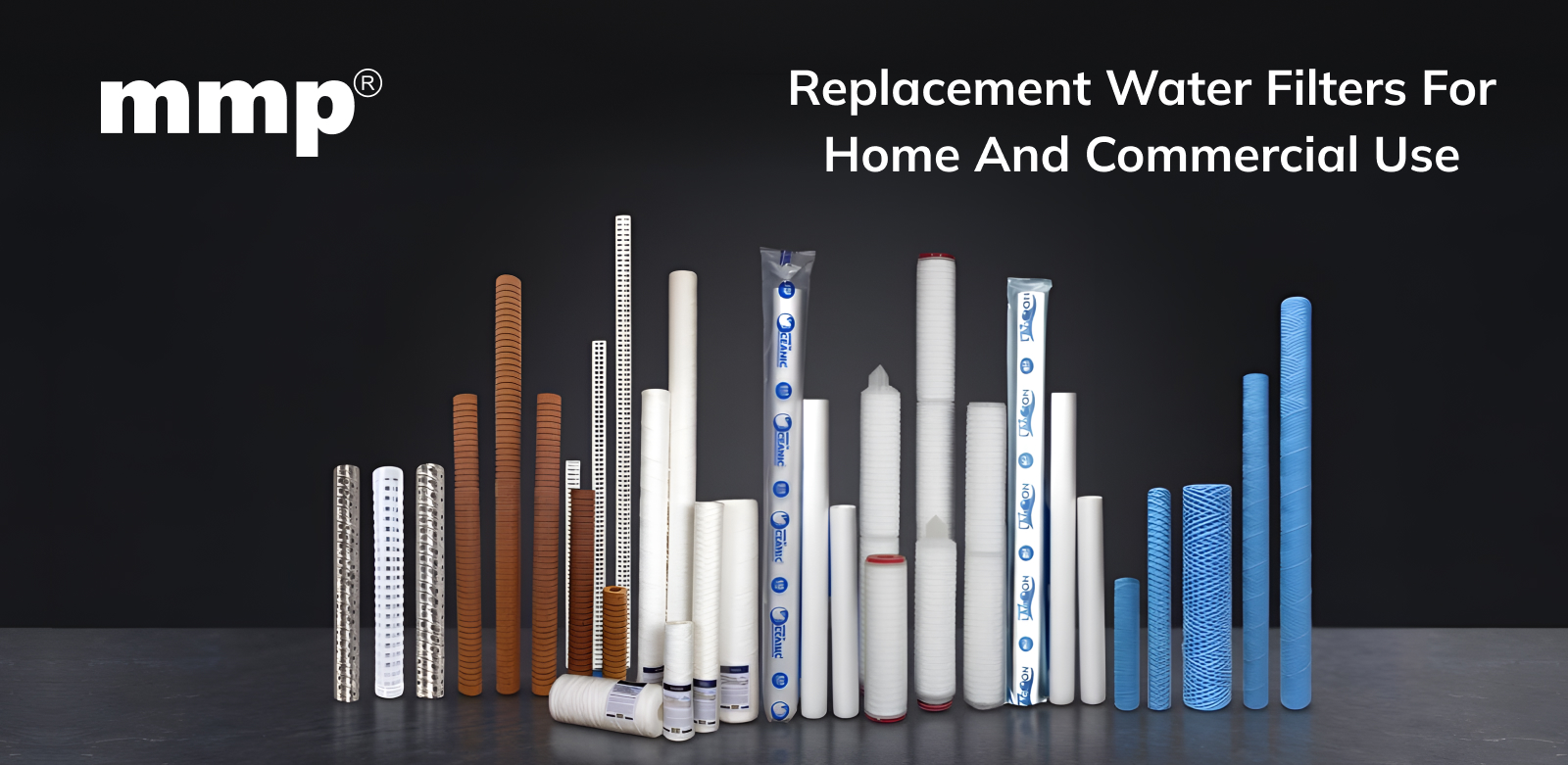
A replacement water filter cartridge is not a spare part to be used to replace the original when it gets dirty. Matching the water quality, flow rate, filtration stage, housing, and application is essential for a replacement cartridge. In a domestic situation, it could be sediment prefiltration or a prefilter before reverse osmosis treatment. In commercial and industrial applications, it is as a minimum higher flow rates, higher contaminant loads, and ongoing process protection. Knowing about the various water filter cartridges and when and why they are used, how often to replace them, and factors to consider for selecting the right cartridge can help avoid unnecessary premature cartridge replacement or unwanted filter cartridge performance.
What Are Replacement Water Filters and How Do They Work?
Replacement water filters are filter elements that are inserted into an existing water treatment system or housing where the original filter cartridge has reached the end of its service life. These filters are capable of removing sediment, suspended particles, and other contaminants from incoming water, if applicable.
Replacement water filters are filter elements that are inserted into an existing water treatment system or housing where the original filter cartridge has reached the end of its service life. These filters are capable of removing sediment, suspended particles, and other contaminants from incoming water, if applicable.
Once water enters the housing, it is directed through the media to be filtered according to the media's characteristics and micron level. As the media loads up with contaminants, pressure drop may increase and flow may reduce, telling the user to change the cartridge.
We offers a broad range of water filter cartridges, including melt blown, wound, PP pleated, PP spun, resin bonded, sediment, antimicrobial wound, and high-flow pleated cartridges for different filtration requirements.
Do Water Filters Need to Be Replaced?
Yes. Cartridges have a limited volume of contaminants they can hold. As the contamination builds up within or on the media, it can start to load the filtration area, which over time can affect water flow and filtration.
However, the cartridge shouldn't be replaced solely based on appearance, as how quickly a cartridge becomes loaded is related to incoming water quality, the level of contamination, daily water use, flow rate, filter type, and micron rating.
We says that normal life of a water filter cartridge is about 3-12 months, depending on water quality and usage, but with commercial systems and high flow, it's likely to need more frequent changes. The best approach is to combine the manufacturer's recommended replacement interval with actual system performance-if flow begins to decline earlier or pressure drop spikes quickly, the cartridge may need replacing sooner.
For a more detailed maintenance approach, businesses and homeowners can refer to this water filter cartridge replacement guide.
Types of Replacement Water Filters
Cartridge construction varies with the different stages of filtration. Using just the cartridge's physical size as the sole replacement criterion can lead to either poor filtration or premature loading. The correct construction must match the stage of filtration, quantity of particles to be captured, and operating conditions to perform satisfactorily.
1. Sediment Filters
Sediment filters can be used to remove suspended particles such as dust, dirt, sand, rust, and mud. These filters are typically used as a first-stage filter to remove particulate loadings before water enters other more sensitive filtration stages.
Sediment filter employs depth filtration to eliminate suspended particles and can be used to treat water as an electricity-free option.
2. Melt Blown Filters
Melt blown cartridges are created by producing polypropylene particles into a depth filter structure. They are popular in many domestic RO installations and other uses requiring sediment and particulate removal.
Melt-blown filters as a lightweight cartridge used in domestic RO applications.
3. PP Pleated Filters
PP pleated filters cartridges feature a polypropylene membrane media in a pleated configuration that allows for a large filtration area within a small cartridge. PP pleated are made from polypropylene.
For users looking for PP pleated filter cartridges, selection can be based on the required micron rating, flow, temperature, and compatibility with the existing housing.
4. Wound Filter Cartridges
Wound filter cartridges utilize a filtration yarn evenly wound over a supporting core. The winding pattern can be varied to achieve different densities of filtration, and therefore this construction is suitable for a variety of liquid applications. Wound cartridges as being wound diagonally over a supporting core.
5. High-Flow Pleated Filters
High-flow pleated filters cartridges are for applications where larger amounts of water need to flow through the filter element, but a smaller footprint is desired. mmp states that their high-flow pleated filter has multiple layers, wide chemical compatibility, and high dirt-holding capacity.
Home vs Commercial Replacement Water Filters
Although the basic principle of filtration is the same, the operational parameters can be quite different from domestic to commercial systems. Domestic systems tend to have lower flows; however, commercial ones may operate for many more hours and, in many cases, have a much larger water throughput.
| Factor | Home Filtration | Commercial Filtration |
|---|---|---|
| Water demand | Generally lower and intermittent | Higher and often continuous |
| Flow requirement | Low to moderate | Moderate to high |
| Contaminant load | Depends on source water | Can be significantly higher |
| Cartridge size | Usually compact | Larger or high-capacity configurations |
| Replacement frequency | Based on usage and water quality | Driven by flow, loading and operating hours |
| Primary objective | Household water quality and protection | Process protection, water quality and operational continuity |
| Selection focus | Micron rating, compatibility and capacity | Flow, pressure drop, media, capacity and process conditions |
Cartridges for residential, commercial, and industrial use, and claims that their product can be tailored to system specifications, micron level, material, and industry application, in addition to its intended use.
How to Choose the Right Replacement Water Filter?
Selecting the right replacement water filters begins with clarifying what type of filtration the original filter system provides. Begin by checking the contaminant. Different filters are suitable for sediment, suspended solids, chemical contaminants, and other water contaminants.
Next, specify the flow rate and the water volume handled during a typical cycle. Consider the housing dimensions and the cartridge connection. If the replacement filter's dimensions don't match or if it doesn't connect to the housing, it will not work properly even if it's technically a compatible design.
- Check the Micron Rating: The micron rating is also one of the most important factors to consider. mmp says that certain cartridges in the range of 0.5- 5 microns can be used in applications where more precise filtration is necessary. 10-50 micron ratings may be appropriate for pre-filtration and larger particles.
- Consider Flow and Pressure: The flow through a cartridge should be enough to meet the needs of the system without experiencing too much resistance. Cartridge resistance is also pressure drop as a filter becomes loaded and can increase, so operating conditions should be assessed initially and regularly.
- Match the Material to the Water: Selection of filter media is based on its suitability to the water or process fluid. Polypropylene is prevalent in general water filtration, but other media and construction may be suitable for specific process streams.
For a more detailed approach to water filter cartridge selection, it is useful to evaluate the complete operating environment rather than selecting a cartridge based on micron rating alone.
How Often Should You Replace a Water Filter?
No, the frequency of replacement is not the same for every system. For example, a cartridge used for clean municipal water in a residential setting will not have the same lifespan as the same cartridge used for filtering heavily sedimented water. Cartridge life will be much shorter with higher-flow commercial systems.
Claims that their water filter cartridges typically last 3-12 months, depending on water quality and use, and high-flow commercial applications may need to be replaced more often.
We recommend observing changes to flow, pressure, water quality, and cartridge condition rather than following a calendar. This provides a better indication of whether a filter cartridge replacement is actually required.
Signs Your Water Filter Needs Replacement
In some cases, a cartridge will require changing prior to the service cycle if the design operating conditions are more severe than anticipated. One or all of the following can accelerate cartridge loading: Contaminant load, flow rate, and hours of operation.
- Reduced Water Flow: A significant drop in flow rate can be an indication that the filter media has become heavily loaded. If the housing and upstream system are not the cause, then the cartridge could be loaded.
- Increased Pressure Drop: The greater the differential pressure across the cartridge, the more the water flow will be restricted. Useful for commercial & industrial applications, differential pressure can be monitored constantly and effortlessly.
- Changes in Water Quality: Check the cartridge if the water is not pure or transparent enough as desired. You run the risk of ruining that particular filtration stage if you use a spent cartridge.
- Visible Loading: Heavy sediment build-up in transparent housings may give a visual cue that the cartridge is near full. Appearance alone should be factored in, along with flow and pressure, not used as the sole measure to replace.
Replacement Water Filters: Cost vs Long-Term Value
The cheapest cartridge may not be the least expensive throughout its entire service life. A lower-cost, fast-loading cartridge may need to be replaced more often and increase maintenance effort. A truly more cost-effective picture is painted when you take into account the service life, filtration quality, maintenance, and replacement costs.
| Consideration | Lower-Cost but Short-Life Filter | Well-Matched Replacement Filter |
|---|---|---|
| Initial purchase | May be lower | May be moderate or higher |
| Service interval | Potentially shorter | Potentially longer |
| Maintenance frequency | More frequent | More predictable |
| Flow performance | Can decline quickly when loaded | Better matched to system requirements |
| Replacement labour | Can increase over time | Can be reduced through planned maintenance |
| Overall value | Depends on actual service life | Based on performance and total operating cost |
The better comparison is therefore the cost per useful operating period, not simply the purchase price of one cartridge.
Why do Home and Commercial choose mmp for Water Filter Solutions?
Water-treatment needs differ significantly between a household, restaurant, pharmaceutical plant, food-processing plant, and industrial water-treatment system. A supplier needs to have enough types and configurations of cartridges to accommodate these needs. Experienced water filter cartridge manufacturer, produces water filter cartridges for commercial, industrial, and residential markets and has a wide selection of sizes, micron ratings, and materials.
The product selection includes melt blown, wound, PP pleated, PP spun, resin bonded, grooved resin bonded, sediment, antimicrobial wound, and high-flow pleated cartridges.
The company also manufactures or assists with manufacturing custom-designed cartridges as per customer requirements, specifications, and industries such as drinking water, dairy, food, beverage, industrial water treatment, the pharma industry, the petrochemical industry, etc.
For businesses evaluating residential and industrial water filter cartridge solutions, this breadth is useful because the same cartridge specification does not necessarily suit every water source or operating environment.
mmp also states that it supports industrial customers in selecting water filters according to their process requirements.
Conclusion
Selecting replacement water filters is not only about selecting a cartridge that will physically fit your existing housings. Various considerations such as filtration media, micron rating, flow, contaminant loading, water quality, and application all affect the overall performance of a water filter cartridge. Your residential system might call for simple sediment and pre-filtration; commercial and industrial systems might utilize larger-capacity cartridges designed to handle continuous use with more substantial contaminants. Consistent filter cartridge replacement is vital, too. Regularly check flow and pressure drop, water quality, and the condition of a filter cartridge to identify when a filter needs to be changed. Use results to develop a replacement schedule instead of changing filters too soon or relying on media that is well past its prime.