Menu

Blog
Filter Cartridge Materials Compared: Melt-Blown, Wound & Pleated
Jul 20 2026
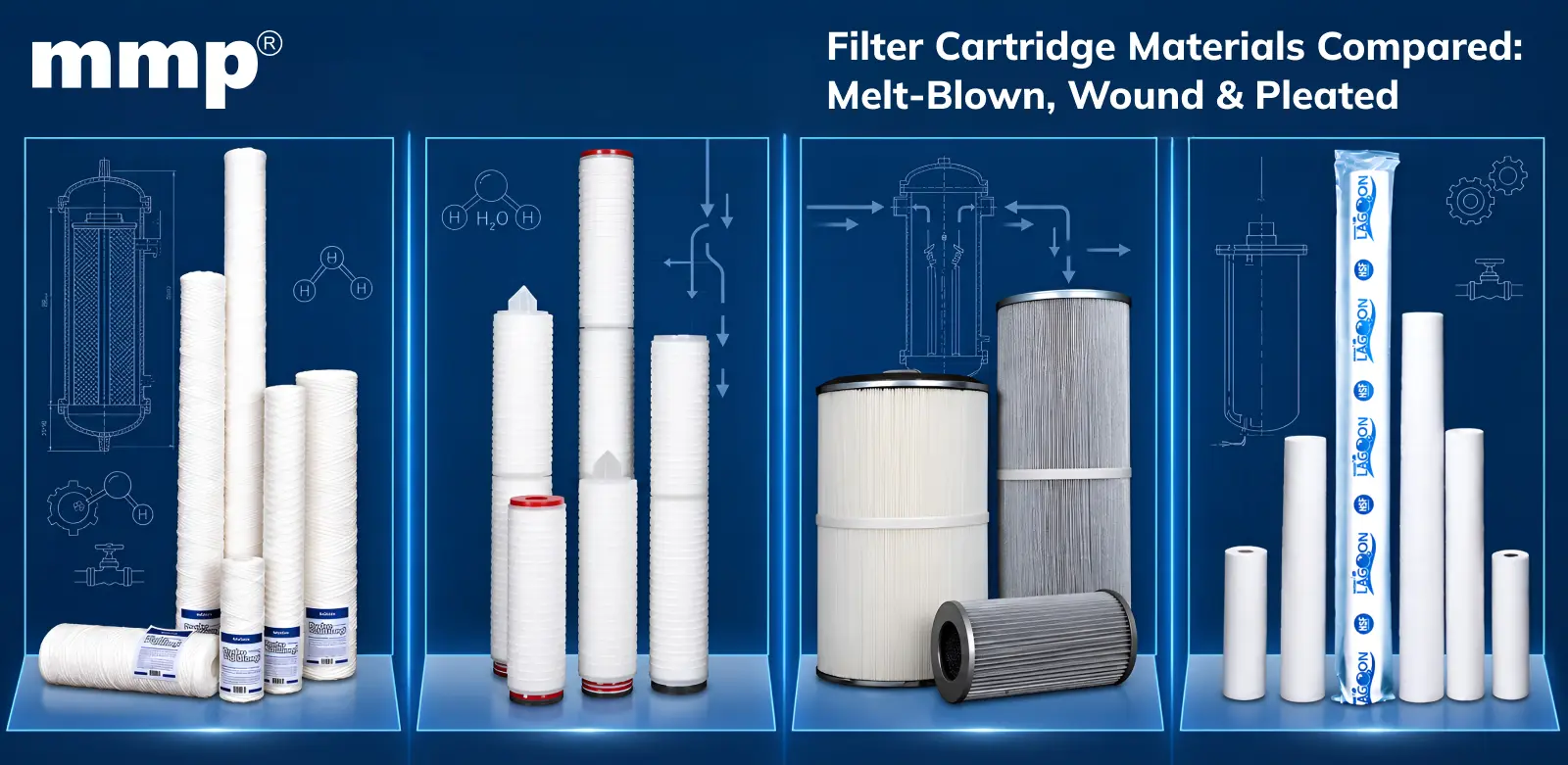
“Filter cartridge selection looks easy until you suffer from the same problem again and again.”
A cartridge goes in. It runs for a few days, perhaps a few weeks. Then the flow begins to fall, the pressure climbs, or the cartridge blocks well ahead of the expected replacement interval. In a great many of these cases the housing is fine and the pump is fine. The fault sits with the cartridge selection.
Melt-blown, wound, and pleated cartridges can appear almost identical from the outside, yet their construction differs considerably, and that difference governs how each one handles dirt loading, flow, pressure drop, chemical exposure, and the replacement cycle that follows. So the more useful question is not which cartridge is best. It is which cartridge suits this fluid, this dirt load, and this operating condition.
The comparison below examines all three constructions so that plant teams, buyers, and maintenance personnel can arrive at a better-informed decision.
Why Filter Cartridge Material Matters
The material and construction of a cartridge decide how it will behave once it is in service.
A cartridge is not operated under laboratory conditions. It may be filtering borewell water, process water, chemicals, oils, inks, coatings, food-grade liquids, or any number of other industrial fluids. Some of these liquids carry light dirt only. Others arrive heavy with sediment. Some are thin and pass through the media without difficulty, while others are viscous and move slowly through the cartridge body, which changes the pressure picture entirely.
The PP filter cartridge material is applied widely for this reason. Polypropylene performs reliably across a broad range of water and process-liquid duties, and it is economical.
But the media alone does not decide performance. How the cartridge is built carries equal weight.
A melt-blown cartridge functions differently from a wound cartridge. A pleated cartridge presents a different structure again. These differences affect dirt-holding capability, flow, pressure drop, micron performance, and service life, and they are the reason two cartridges of the same rating can behave nothing alike.
Selection should not stop at the micron number. The full operating condition has to be examined. Points to be reviewed before any cartridge is confirmed:
- Liquid type and chemical nature
- Particle load and particle size distribution
- Operating pressure and temperature
- Flow rate requirement
- Expected replacement frequency
Understanding Different Types of Filter Cartridge Materials
In purchasing discussions the word "material" gets applied loosely to describe the whole cartridge type. Technically, melt-blown, wound, and pleated are not materials at all. They are cartridge constructions, and the distinction is worth keeping.
The media may be polypropylene, cotton, polyester, nylon, glass fibre, or something else. Construction tells you how that media has been arranged inside the cartridge body, and it is the arrangement that produces the performance the user actually experiences.
Melt-blown Filter Cartridge:
A melt-blown filter cartridge is generally made from fine polypropylene fibres. These fibres form a depth structure, which means particles are captured through the body of the cartridge and not merely at the outer face.
String-wound Filter Cartridges:
Wound filter cartridges are produced by winding yarn around a centre core. The controlled gaps between the wound layers trap particles as the liquid works its way inward through the depth.
Pleated Filter Cartridge:
A pleated filter cartridge uses folded media. The folds create substantially more filtration area within the same cartridge envelope, and this assists flow and pressure drop wherever the fluid is suited to pleated filtration.
That is why two cartridges carrying an identical micron rating may still behave differently in the same system.
See Also: String Wound vs. Melt Blown Filter Cartridges: Key Differences for Water Filtration
Quick Comparison Table: Melt-Blown vs. Wound vs. Pleated Filters
The table gives a quick view. The final decision must still rest on the real working conditions at the site.
| Point of Comparison | Melt-Blown Filter Cartridge | String-Wound Filter Cartridge | Pleated Filter Cartridge |
|---|---|---|---|
| Basic structure | Fine fibres formed into a depth cartridge | Yarn wound around a central core | Folded media with more surface area |
| Common use | Sediment and particle removal | Heavy sediment and mixed particle load | Fine filtration and higher flow support |
| Dirt-holding style | Holds dirt through depth layers | Holds dirt through wound layers | Uses pleated media area to hold particles |
| Pressure drop | Depends on micron and dirt load | Depends on winding, yarn, and flow | Often lower when used on suitable fluids |
| Media options | Commonly polypropylene | PP, cotton, polyester, glass fibre, and others | Commonly PP and other membrane or media options |
| Typical application | Water, RO pre-filtration, process liquids | Water, chemicals, oils, industrial fluids | Water, pharma, food, electronics, chemicals |
| Reuse | Generally disposable | Generally disposable | Some types may be washable, depending on the design |
| Main selection point | Sediment load and micron need | Yarn, core, dirt load, and compatibility | Surface area, flow, and filtration precision |
What Is a Melt-Blown Filter Cartridge?
A melt-blown cartridge is a depth filter, typically manufactured from polypropylene fibres formed into a layered structure. Liquid enters the cartridge, the larger particles are held within the outer layers, and the smaller particles travel further inward before they are captured somewhere within the media depth.
That staged capture is what makes melt-blown filter cartridges so widely used for sediment filtration and general pre-filtration. They appear across water treatment, RO pre-filtration, wastewater filtration, chemicals, inks, coatings, and a broad spread of other liquid-filtration duties. They are commonly specified where the system simply needs a practical, economical cartridge to remove dirt, rust, sand, silt, and suspended particles. mmp’s Oceanic Melt Blown Filter Cartridges sit within this category and are supplied for depth filtration across water and process-liquid applications.
Melt-blown generally makes sense when:
- The liquid carries fine and coarse sediment together
- Depth filtration is the actual system requirement
- The cartridge is being used as a pre-filter
- Regular replacement is already expected
- A practical sediment-removal option is what the plant needs
What Is a String-Wound Filter Cartridge?
A wound filter cartridge is produced by winding yarn around a central core. The winding creates layers with controlled gaps, and particles are trapped within the depth of the cartridge as liquid passes through those successive layers. String-wound cartridges are frequently applied where the liquid carries heavier sediment, or a mixture of particle sizes that a single-density media would struggle with. They are common across water treatment, chemical processing, oils, plating solutions, process fluids, and general industrial filtration.
The useful part of the wound construction is that it can be produced with different yarn and core options. The yarn influences how the cartridge filters. The core supports it and holds the shape under working pressure. The core for filter cartridges carries more importance than most buyers assume. Where the core material is unsuitable for the fluid, the temperature, or the pressure, the cartridge will not perform as intended, regardless of how well the yarn has been selected. Cores may be made from polypropylene, stainless steel, tinned steel, or other materials, depending entirely on what the application demands.
Wound cartridges are often considered when:
- The liquid carries heavier sediment
- Mixed particle sizes are present
- Depth filtration is required
- Yarn and core selection genuinely matter
- The fluid condition is more demanding than a simple clean-water line
What Is a Pleated Filter Cartridge?
A pleated cartridge uses folded filter media, and those folds create considerably more filtration area inside the same cartridge dimensions. The additional area helps the cartridge support better flow and a lower pressure drop, provided the fluid is suited to pleated filtration in the first place. That condition matters, and it is often overlooked.
A PP pleated filter cartridge uses polypropylene media together with polypropylene support parts. It is applied across water treatment, food and beverage, pharma, electronics, chemicals, and process-liquid filtration.
Pleated cartridges are often selected when:
- The fluid is cleaner than a heavy sediment line
- More filtration area is required
- Lower pressure drop is important to the system
- The process demands finer filtration
- Flow stability is a priority
Read More: Filter Cartridges vs. Filter Bags: Key Differences & Uses
Head-to-Head: Performance Comparison
The real difference between the three constructions emerges only when they are compared against actual operating requirements, not catalogue specifications.
1. Dirt-holding capacity
Filter cartridge dirt-holding capacity depends on the media and the construction together. Melt-blown and wound cartridges both work as depth filters, so they retain particles through the body of the cartridge rather than at a single face. Pleated cartridges rely on surface area instead. In cleaner fluids, or where the particle load is not especially heavy, that can deliver good service life.
For heavy sediment, melt-blown or wound cartridges are usually considered first. For cleaner fluids where flow and surface area carry more weight, pleated cartridges may prove the better fit.
2. Flow and pressure drop
Pleated cartridges often support better flow because of the larger filtration area. That does not mean they should be applied everywhere.
Where the incoming liquid carries too much dirt, the pleats load quickly and the pressure drop rises faster than expected. Melt-blown and wound cartridges are equally capable of delivering stable performance, provided they have been matched correctly to micron rating, flow, and dirt load.
3. Micron rating
The filter cartridge micron rating by material needs to be understood carefully. A 5-micron cartridge does not behave the same way across every construction.
Place a 5-micron wound cartridge, a 5-micron melt-blown cartridge, and a 5-micron pleated cartridge in the same line. All three will remove particles at that size. Their dirt loading, pressure drop, and service life may differ substantially.
4. Absolute vs nominal rating
Buyers should also understand absolute vs nominal filter rating. A nominal rating means the cartridge removes a certain percentage of particles at the stated size, so a proportion will pass through. An absolute rating is more controlled and generally refers to a much higher removal level at that same micron size.
For general sediment duties, nominal is usually sufficient. Where the process cannot tolerate strays, absolute is the safer specification.
5. Chemical compatibility
Filter cartridge chemical compatibility depends on more than the media. The core, the end cap, the seal, the support material, and the operating temperature all contribute.
Polypropylene performs well across many applications. It does not perform well in every chemical condition. Fluid type, pH, temperature, and exposure time should all be checked before a cartridge is confirmed.
6. High-viscosity fluids
A filter cartridge for high viscosity fluids requires more care than most duties. Thick liquids move slowly through the media and generate a higher pressure drop than the flow rate alone would suggest.
Cartridge type, micron rating, housing size, flow rate, media compatibility. In viscous applications, all of these need verification before anything is finalised.
Which Material Should You Choose?
There is no single answer that covers every application.
Melt-blown Cartridge:
Choose a melt-blown cartridge where the system needs practical depth filtration for sediment, dirt, rust, and suspended particles. Water filtration, RO pre-filtration, and general industrial liquid duties are where it performs best.
Wound Cartridge:
Choose a wound cartridge where the liquid carries heavier sediment or mixed particle sizes, and where yarn and core selection genuinely affect the result. It suits many industrial duties in which depth filtration is the requirement.
Pleated Cartridge:
Choose a pleated cartridge where the fluid is relatively cleaner and the system needs more surface area, better flow support, or finer filtration.
A simplified guide:
- Heavy sediment: consider wound or melt-blown
- Basic water pre-filtration: consider melt-blown or wound
- Cleaner fluids with finer filtration needs: consider pleated
- High flow and lower pressure drop: review pleated options
- Chemical or process fluids: check compatibility first
- Thick liquids: check viscosity and pressure drop before selecting
The cartridge must match the application. Not the price, and not the micron number on its own.
Industry-Specific Recommendations
Water filter cartridges are used across industries for markedly different reasons, and the correct construction shifts with the duty.
- Water treatment: Water treatment plants generally apply melt-blown or wound cartridges for sediment control and RO pre-filtration. Pleated cartridges enter where finer filtration or a higher surface area becomes necessary.
- Food and beverage: Process water, utility water, pre-filtration. That is most of the requirements here. PP melt-blown and PP pleated cartridges are both reviewed, and the level of filtration required usually settles the choice.
- Pharma and healthcare: These applications need much closer control. Pleated cartridges are commonly applied where finer filtration and cleaner fluid streams are required, though process validation and internal quality requirements always have the final say on what is actually specified.
- Chemicals and process liquids: Chemical filtration depends heavily on media and core compatibility. Wound cartridges prove useful where yarn and core choices carry weight. Melt-blown and pleated cartridges are also applied, depending on the chemical involved and the duty.
- Electronics and plating:Fine particle control and stable flow are the requirements. Melt-blown or pleated cartridges are selected according to fluid type, particle size, and how sensitive the process is.
- Oils, inks, coatings, and viscous fluids: Thicker fluids demand more care at selection. Viscosity, temperature, micron rating, flow rate, expected pressure drop. Check all of them before the cartridge is confirmed.
Common Mistakes When Choosing Filter Cartridge Material
The most common error is selecting purely by micron rating. Micron rating matters, but it does not explain the full performance of the cartridge in service, and treating it as the whole answer produces exactly the failures buyers complain about.
Common mistakes include:
- Selecting only by price
- Selecting only by micron rating
- Ignoring chemical compatibility
- Ignoring core material
- Applying pleated cartridges directly on very dirty first-stage lines
- Replacing melt-blown with pleated without reviewing the system
- Overlooking the difference between nominal and absolute ratings
- Repeating an old purchase order after water quality has changed
How to Extend the Life of Your Filter Cartridges
Cartridge life is largely a reflection of how well the cartridge was matched to the duty at the start.
To improve cartridge life:
- Use a pre-filter where the sediment load is high
- Avoid an excessively fine micron rating at the first stage
- Confirm flow rate before selecting the cartridge
- Monitor pressure drop during operation
- Replace cartridges before flow falls too low
- Clean the housing at every changeout
- Check seals and end caps before installation
- Retain the same approved specification for repeat orders
Why Choose mmp Melt-Blown, Wound & Pleated Filter Cartridges?
With more than three decades of experience in the filter cartridge manufacturing industry, mmp has established itself as a trusted global name for Melt-Blown, Wound, and Pleated Filter Cartridges. The company’s extensive expertise enables the design and manufacture of a complete range of filter cartridges tailored to diverse industrial needs, ensuring superior filtration efficiency, durability, and consistent performance across applications. Beyond cartridges, mmp also supplies advanced filter cartridge manufacturing machines customized to client requirements, empowering businesses worldwide to achieve reliable and cost-effective filtration solutions. Backed by decades of technical know-how, stringent quality standards, and a strong global supply network.
Signs That Your Filter Cartridge Needs Replacement
A cartridge should be replaced before it starts affecting the process, not after.
Rising pressure drop is the most reliable indicator. As dirt accumulates inside the cartridge, liquid struggles to pass through the media, flow begins to fall, and equipment downstream of the filter may no longer receive adequate supply.
Other indicators include:
- Flow lower than the normal operating level
- Higher pressure across the housing
- Visible dirt or discoloration on the cartridge body
- Change in liquid clarity
- Frequent clogging downstream of the filter
- Poor RO or process-equipment performance
- Repeated complaints from maintenance or production teams
Benefits of Choosing mmp Filter Cartridges
mmp supplies melt-blown, wound, and pleated cartridges across a range of filtration duties. That allows buyers to compare cartridge construction on the basis of the actual application, rather than on whatever happens to be readily available.
Key benefits include:
- Multiple cartridge types within a single range
- Options for sediment, depth, and fine filtration
- Products for both water and process-liquid filtration
- Support through core and wound-cartridge machine expertise
- Customisation across size, micron, media, and fitment
- Practical support for buyers managing several filtration points
The value is straightforward. The cartridge gets matched to the process, instead of one product being forced into every application.
Conclusion
The correct selection depends on the liquid, the dirt load, the flow rate, the temperature, the chemical compatibility, the micron rating, the pressure drop, and the replacement pattern that follows from all of them.