Menu

Blog
Everything You Need to Know About Air Filters: Selection, Efficiency & Maintenance
Sep 16 2026
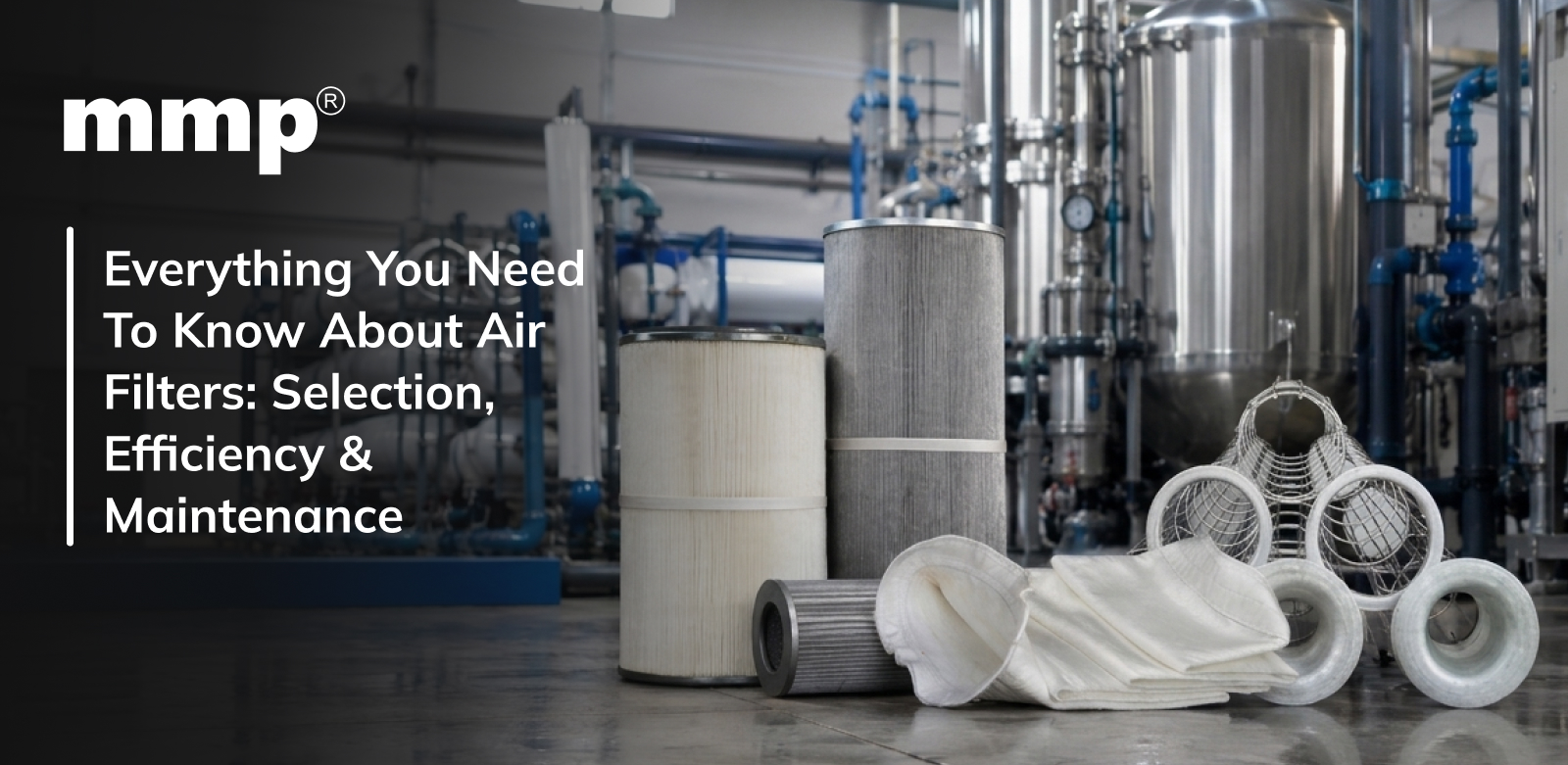
An air filter is a part of keeping our air cleaner, our machines safer, and our industrial processes in order. However, selecting the right one is not just a question of finding the very best. Choosing the correct solution is critical and depends on the nature of the dust, air volume flow rate, operating temperature, humidity levels, contact with chemicals, pressure drop across the filtration apparatus, and the filtration equipment design. Air filter cartridges are one of the filtration options used in industrial systems where efficient particulate removal and suitable airflow are required. When selecting industrial filters, understanding the way individual filters perform, their operating characteristics, and when a filter requires attention will prevent overspecification and unnecessary operational costs.
What Is an Air Filter and Why Does It Matter?
An air filter's filtration component separates contaminants from the air or gas. The particulate matter could be powder, fibers, fumes, or simply dust depending on what is being filtered.
However, the filter component is only a part of the story; the collector, fan, ductwork, cleaning arrangement, filter medium, and operating conditions also contribute to the outcome. mmp's current range of air filters includes pleated filter bags, pleated cartridges, dust collector filter bags, dust collector filter cages, and filter bags.
For example, air filter cartridges are cylindrical filtration elements designed for dust collection and air pollution control systems. The mmp product line features many varied types of filter constructions, with many varied materials, to address process-specific demands, which could be anything from dust specifications, temperature conditions, or moisture.
The main concept is simple: remove process debris effectively but allow your process the air needed.
Types of Air Filter Cartridges
There are, not surprisingly, a variety of applications and associated filtration problems and, therefore, several forms of filter construction appropriate to each application. Appropriate construction leads to better filtration, and to easier maintenance and more prolonged service.
1. Pleated Air Filter Cartridges
Pleated cartridges fold their filter medium so that more surface area for filtration can be accommodated on a reasonably compact element. Such a filter construction may offer a greater effective filtration area with a smaller, but equally functional, collector.
mmp notes that its pleated cartridge filter contains a folded filter medium that filters particulates and contaminants from gas or fluid. Its product line is positioned for dust collecting and air pollution control applications.
2. Pleated Filter Bags
Pleated filter bags replace the cylinder bag configuration with folded media. This gives much more available filter area for the amount of media, increasing the amount that is packaged into one container.
This would be applicable if an existing dust collector had space constraints but also needed more filtration area. mmp writes that their pleated bag filters will increase the amount of filter surface area many times that found in conventional bags.
3. Conventional Dust Collector Filter Bags
Standard filter bags are the most common type and are installed over the supporting cage within the baghouse or dust collector. Dust collector filter bags are available in a variety of filter media, including polyester, polypropylene, meta-aramid, PPS, P84, fiberglass, PTFE, and others, depending on the application and operating conditions.
High heat will determine a different type of media than moisture, corrosive chemicals, abrasive dust, or very fine powders.
4. Filter Media Makes a Difference
When thinking about constructing a filter, selecting its media should go hand-in-hand. Filters of the same size may be constructed and operate very differently depending on the permeability, chemical-resistant properties, temperature-resistant properties, or even dust-release properties of the chosen media.
This is precisely why selecting industrial filters should be tied to the actual process and not the dimension of the filter itself.
Understanding Air Filtration Efficiency and Ratings
Understanding filter efficiency and ratings is essential when selecting an air filtration system for industrial applications. The right filter must balance particulate removal with airflow and pressure drop to maintain overall system performance.
- Particle Size and Dust Characteristics: There's no one kind of industrial dust. A certain process might be creating coarse particles, fine powders, fibers, fumes, or other contaminants all at once.Knowing how to size particles shows what media and construction design of the filter you need.
- Pressure Drop: This represents the resistance offered when airflow is channeled through the filter. An increase may be observed when dust begins to build up on the media. An increase in differential pressure provides operators a good idea of how their filtration system is operating.
- Efficiency Should Be Balanced With Airflow: It should not be forgotten that the purpose here is not solely for maximum filtration efficiency. It is rather for the desired particle retention to be achieved together with good airflow, pressure drop, service life, and an acceptable power consumption.
For a continuously running air filtration system with a large product throughput, it is a necessary compromise.
How to Choose the Right Air Filter Cartridges?
Filter selection starts with knowing the application. Basic operating data about the existing equipment must be gathered by plant personnel before ordering replacement air filter cartridges. Work with the type of dust to be collected, flow rate required, operating temperatures, level of moisture, types and levels of chemical exposures, cleaning system used, and type of collector. While the existing filter dimensions are important, they are not the only factor in selection.
1. Match the Filter to the Dust
Different fine particles from coarse and/or abrasive dust. Different stickiness of particles may cause a variety of cleaning problems, with different fiber particles behaving differently to dense dust-like particulates. For dust collection and cleaning, appropriate selection of filter media is important.
2. Check Collector Compatibility
Replacement filters should also have appropriate dimensions, arrangement, and sealing, as well as compatibility with the cage and adequate surface area for filtration if it is to be considered technically efficient. As stated before, it would not be expected of a technically sound filter to operate efficiently without operating with the collector.
3. Consider the Cleaning Method
The pulse-jet collectors rely on a regular cleaning sequence that keeps the filter media free from build-up dust. The filter media has to stand up to this cleaning action without being unduly mechanically stressed.
A poorly matched system may result in increased pressure drop and reduced lifespan.
Air Filter Selection Factors for Industrial Applications
Effective air filter selection requires a closer look at the environment in which the filter will operate. Factors such as temperature, moisture, dust characteristics, airflow, and chemical exposure can all influence how well a filter performs. Considering these conditions helps ensure the selected filter is compatible with both the process and the filtration equipment.
1. Operating Temperature
The first parameter to specify. What is the continuous operating temp, the maximum possible temp, and the expected temperature swings? All these parameters influence media choice. A filter that works in an environment with ambient temp may not be satisfactory in a hot process-gas application.
2. Chemical Exposure
The dust or gas flow stream may contain chemicals that will damage inappropriate filter media. Chemical compatibility requirements should be taken into account along with the temperature and mechanical parameters.
mmp has filter bags available using several media (PTFE, PPS, aramid, polypropylene, and fiberglass) to enable the construction of the filter for various industrial conditions.
3. Moisture and Humidity
Moisture can also affect the way collected dust behaves. Certain powders will be sticky or deposit under high moisture, resulting in cleaning difficulties. This provides awareness of moisture levels so premature blinding and unnecessary pressure drops are avoided.
4. Dust Loading
The rate of filter loading depends on the amount of dust that goes into the collector. It's obvious that high dust levels will put more load on the filter than a low-loading application. This leads to specifying the filtration equipment based on process loads.
5. Airflow and Pressure Drop
Air volume and pressure drop should be analyzed as a function of each other. The filter should have the appropriate free surface area to meet the air volume without causing undue resistance.
mmp indicates that its air filtration solutions offer efficient dust separation at a minimal pressure drop and within operating parameter specifications.
Why Air Filter Selection Matters in Industrial Facilities?
The selection of a filter has direct relevance to the effectiveness of the dust collection system. A wrong choice will be visible either in frequent cleaning, excessive pressure drop, reduced filter life, evidence of dust leakage, or uneven air flow. For companies running an industrial air filtration unit for a full-time operation, each of these effects can translate to higher operating costs in the long run.
More frequent replacement leads to further material costs plus labor in servicing it.
The downtime due to unanticipated failures represents an even more substantial impact on the operation. The flip side is that an appropriate filter offers more consistent airflow and particle collection along with planned maintenance intervals. When selecting a replacement filter, it shouldn't only matter that it "fits the dimensions of the old filter." The process, dust type, or collector may have changed, and if so, the old specification is not suitable.
Requirements may vary widely from one area of production to another; food and beverage or dairy plants are special cases for both air and water filtration due to the high correlation of hygiene/contamination with the production area. mmp discusses these requirements in water & air filtration for food and dairy plants.
Maintenance and Replacement of Air Filter Cartridges
No matter the selected filter. It will need proper air filter maintenance. In air filters, the main point is the detection of degradation before system failure, not maintenance of the filter only (pressure drop, damage, leakage through the filter, or inability to be cleaned).
- Monitor Differential Pressure: The filter press filter is the indicator of the filter loading. A gradual increase in pressure drops as the filter gets loaded with dust. Sudden or excessively steep rises mean possible troubleshooting. Possible reasons could be excessive dust load, inefficient cleaning, or perhaps moisture, use of wrong media, or non-standard airflow.
- Inspect Filter Condition: Visual inspection can be used to determine media damage, broken seals, improper wear of seals, dust leakage, and faulty installation. In a baghouse, cages should be inspected as well. An improperly installed or damaged cage will put excessive physical stress upon the filter bag.
- Check the Cleaning System: Under such conditions, a filter may be choked although it is efficient in design. This situation necessitates checking pulse-jet cleaning system pressure, pulse valves, and timing and frequency of cleaning as part of the routine maintenance procedures.
- Plan the Air Filter Change: An air filter change should be a decision based on how it's running, not a dated requirement. Air filter replacement can be a product of pressure drop, airflow, dust carryover, or damage, or of its own history. mmp also reports that high pressure drop, low flow rate, or visual signs of clogging can determine filter replacement needs.
Air Filter Problems and How to Prevent Them
It's rare for a problem where only a filter issue comes to the fore not to indicate issues elsewhere in the system. Simply replacing the filter is a waste of time if you do not ascertain why the filter has blocked up.
1. Rapid Increase in Pressure Drop: Over-dust loading, insufficient cleaning, dampness, or an improper media selection could cause the resistance to build rapidly.
Prevention: Monitor the trend in the pressure drop and analyze irregular changes rather than constantly replacing filters without understanding why.
2. Short Filter Life: Premature failure will occur from factors such as abrasion, excessive temperature, chemical contact, mechanical load, or inadequate cleaning procedures.
Prevention: Select the filter media appropriate to the real system environment and examine the failed filter for evidence of a particular failure mode.
3. Dust Leakage: This happens because the media itself has been damaged; the seal itself has come loose/been installed incorrectly or is actually flawed, or the connection issue resides with the collector.
Prevention: At the time of standard service checks, examine the filter, seals, filter mounting, and support arrangement.
For systems using conventional bags, bag filters are available in multiple materials, configurations, coatings, fittings, and custom dimensions. mmp is quoted as saying these filters were intended for high dust, industrial applications, and hard industrial applications.
4. Excessive Cleaning Frequency: Excessively short filter-clean intervals may or may not indicate a problem with the cleaning cycle and include a condition of high dust load, incorrect airflow, wrong media, or presence of moisture.
Prevention: Assess the filter and the entire collection system as a whole.
Benefits of Using High-Efficiency Air Filter Cartridges
In the right context, high-efficiency air filters can do much more than just remove particles more effectively, it can even aid in greater stability of the filtration system as a whole.
1. Effective Dust Capture
When the correct filter is selected, it will trap the particles that result from the process and also prevent overexposure from those particles to future parts of the system. This helps reduce unwanted dust accumulation on downstream equipment and components.
It can also support more stable system performance by limiting the amount of particulate that continues through the filtration process. As a result, the filtration system can operate more effectively while helping protect equipment from unnecessary contamination.
2. More Filtration Area in a Compact Design
Pleated constructions allow for the inclusion of a greater quantity of media within a given space. This can be particularly useful where there is insufficient room within a current dust collector for a larger or higher capacity cartridge.
mmp refers to pleated cartridges as a method to maximize the amount of dust-collection surface area and lists high-efficiency filtration and low-pressure drop as a benefit of their air-filter products.
3. Potentially Longer Service Intervals
When there is good matching between the media and dust, the operating conditions (airflow, the cleaning method), and the effective life can be achieved for much longer operating times.
However, this cannot guarantee that all the high-efficiency filters will have a longer life compared to other filter categories. The service life still relies upon its application.
4. Better Equipment Protection
A good filter system will not allow dust and particulates to continue to move downstream. This will help minimize unwanted deposits and prevent wear on components later in the system.
For applications that specifically require a dust collector filter bag, the conventional cage-supported bags manufactured from needle-felt media are also referred to as conventional bags in mmp. In demand from difficult environments for filter media, the company proposes the respective products for industrial use.
5. Easier Maintenance Planning
The filter will give the expected filtration performance, and maintenance technicians will monitor the pressure drop and maintenance intervals accordingly using a database related to the use. Therefore, the substitution becomes part of the preventive maintenance plan instead of a forced maintenance.
Why do businesses choose mmp for Air Filter Solutions?
While a variety of products is always beneficial to an industrial filtration supplier, knowledge of various applications often weighs equally heavily. Various processes require different types of media, construction, sizes, coatings and fitment of filter products. Based in India, mmp is an air filter cartridges manufacturing company that possesses over 30-years expertise in filtration, and supplies air-filter products for industrial dust collection and air-pollution control applications.
Their filters, the supplier says, are based on user application parameters, such as characteristics of the dust particles being filtered, temperature, and moisture. Use industries includes cement and construction, metal fabrication and welding, pharmaceutical and food industries, power generation, and automotive and general manufacturing
Conclusion
The factors that go into selecting an appropriate filter extend further than the filter itself. Dust to be collected, air flow rate, temperature of air flow, amount of moisture in air, exposure to chemical elements, type of cleaning performed, pressure drop, and overall collector design all impact upon how the filter performs. Planning any air filtration needs such as air filter change should first consider balancing particle filtration with the capacity for adequate air flow, expected life of the filter element, energy efficiency requirements, and overall maintenance needs of the system. mmp has several filter products available for use in dust collection and air pollution control systems, such as filter cartridges, pleated filters, bag filters (standard filter bags), and components necessary for them. By assessing the process itself, a suitable filter can then be chosen.