Menu

Blog
Polypropylene (PP) Cores: Applications, Benefits & Selection Guide
Aug 25 2026

Cut open a used filter cartridge sometime and slice it down the middle. Right in the center there's a rigid plastic tube, and that's what's holding the whole thing together. That tube is the core. It doesn't catch a speck of dirt, not one, but pull it out and the cartridge just folds in on itself.
Nobody really thinks about the core because it isn't the part doing the actual filtering. But it's quietly running the show. It keeps the media from losing shape, keeps fluid moving through the center without choking up, and stops the cartridge from crushing once pressure builds. Almost every core in water and process filtration is made from polypropylene, and that's not really an accident.
Get the core wrong, and even good media underneath won't perform the way it should. Get it right and, honestly, you forget it's even in there. This guide walks through what PP cores are, why they matter, where they're used, and how you'd go about picking one.
What are polypropylene (PP) cores?
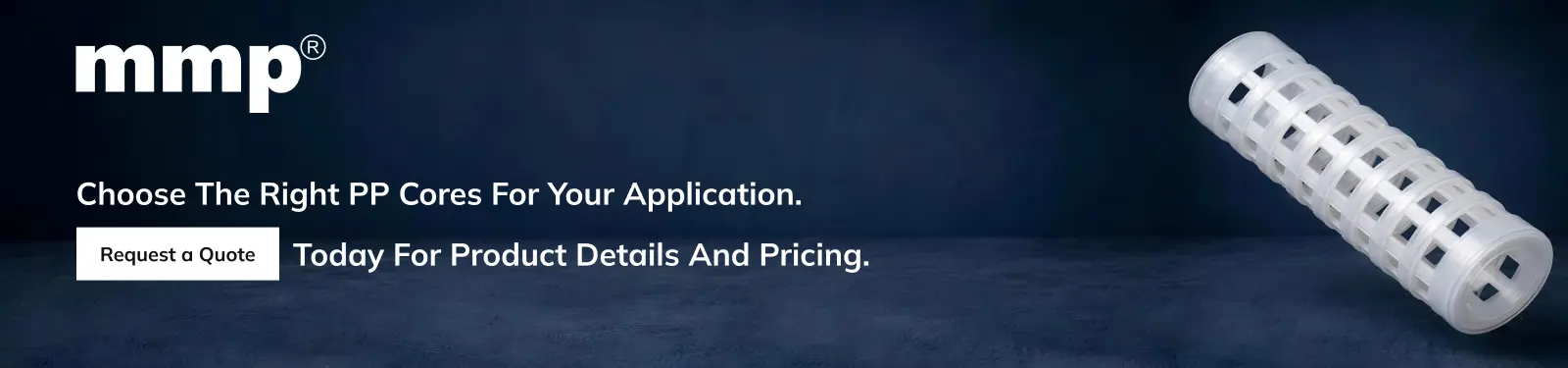
A PP core is a rigid polypropylene tube that sits inside a filter cartridge and supports the media wrapped around it. Think of it as the spine. The media does the filtering, the core keeps it standing upright.
Here's why that job matters. When water or process fluid is pushed through a cartridge, it puts real force on the media. Spun and wound cartridges are the clearest case, because they're really just layers of fibre with nothing rigid on the inside. Leave them unsupported and, as the filter fills with dirt and the pressure climbs, that fibre can squash, shift, or cave inward. A polypropylene core stops all of that:
- Holds the media at a fixed diameter so it can't compress or shift
- Keeps the central flow channel open as the cartridge loads
- Takes the mechanical load so the filtering layers never have to
The same component goes by a few names. You'll hear pp core, polypropylene core, and core for filter cartridge, and they all point to the same thing: the plastic support tube at the heart of a cartridge. It shows up in water filters, in spun and wound cartridges, and in plenty of process filters. Anywhere media needs something solid to build itself around, there's a core doing the holding.
Key features and properties
Why polypropylene, out of every material available? A few of its properties just happen to fit filtration almost perfectly. Here's what it actually brings to the table:
- Corrosion-free in constant water contact, where a metal core would eventually rust
- Chemically resistant to the acids, alkalis, and cleaning chemicals common in water and process lines
- Lightweight, so cartridges are easy to handle and quick to change
- Dimensionally stable, holding the media at a fixed shape under load
- Heat-tolerant across normal water service, comfortably to around 60°C continuous
- Material-matched to PP spun and wound media, which are often polypropylene too
That last point carries a quiet manufacturing advantage. Because the core and the media are the same material, they expand, contract, and age in step with each other, and the whole cartridge stays within one clean material family. Anyone building a PP spun filter will find a matching polypropylene core is the natural structural partner, not an add-on.
Top applications across industries
PP cores turn up wherever cartridge filtration does, which is a lot of ground. Any industry pushing water or fluid through a supported cartridge is relying on a core doing its quiet work underneath:
- Water treatment — supporting the sediment and pre-filtration cartridges that guard RO membranes, pumps, and downstream gear
- Food and beverage — handling process water and rinsing, where the corrosion-free, single-material build is a real plus
- Pharmaceutical and healthcare — controlled pre-filtration, the kind of work where consistency isn't optional
- Chemical processing — chosen deliberately for chemical resistance, since a metal core would corrode in aggressive fluids
- Manufacturing and utilities — pulling sand, rust, and silt out of utility water before it reaches sensitive machinery
The thread running through all of it is simple. Wherever a water filter cartridge is doing sediment control or pre-filtration, there's a polypropylene core inside holding it together. The industry changes. The core's job doesn't.
The main benefits of using a PP core
If the features are what the core is, the benefits are what it does for you. And the big one is consistency.
A well-made polypropylene core keeps a cartridge behaving the same from its first day to its last. Because the media stays locked at a fixed shape, the cartridge loads evenly, the pressure drop rises along a predictable curve, and the filter reaches its expected service life instead of dying early from collapse or channeling. That predictability turns filter replacement from a guessing game into something you can schedule.
The rest of the benefits stack on top of that:
- No rust in clean water, thanks to corrosion resistance
- Simpler stock, since one chemically resistant core type covers a wide spread of fluids
- Easier changeouts, because the core is light to handle
- Lower cost per cartridge, as polypropylene costs far less than metal, which matters on a regular replacement cycle
Put plainly: a PP core gives you reliable performance at a sensible price. That's exactly what a consumable part should do, and it's why polypropylene has become the default rather than the exception.
Technical specifications to consider
This is where selection gets specific, and where a bit of care pays off. Not every PP core is the same, and matching the spec to the duty is what separates a cartridge that lasts from one that quietly deforms in service. The variables that matter are diameter, length, wall strength, and end-fit.
Most pp core manufacturers offer a few build grades, each aimed at a different level of duty:
| Core type | Built for | Typical use |
|---|---|---|
| Standard PP Core | Normal water and light process duty | General sediment and pre-filtration cartridges |
| Reinforced PP Core | Higher pressure and heavier loading | Industrial lines with high pressure drop or demanding flow |
| Jumbo PP Core | Large-diameter, high-flow housings | Big-flow systems needing a wider core, around 38 mm OD |
A quick read on when each one fits:
- Standard handles the bulk of everyday water filtration, where pressures are moderate and the job is mostly holding shape.
- Reinforced adds wall strength for when a loaded cartridge builds enough pressure drop to crush a standard core, common in heavier industrial service.
- Jumbo, at 38 mm outer diameter, is made for the large high-flow cartridges in big housings, where you need a wider, stronger core to support extra media and cope with the flow.
Grade aside, three dimensions have to match your cartridge and housing exactly: the outer diameter (which sets the media's inner shape), the length (which has to match the cartridge), and the end configuration (open ends or specific fittings). Nail these and the cartridge assembles cleanly and seals the way it should. Miss them and you get bypass or a sloppy fit, and no amount of good material will save you. This is the part buyers most often get slightly wrong, so it's worth checking against the real housing rather than a spec sheet from memory.
How to choose the right PP core
Choosing a core starts with the cartridge and the conditions it lives in, not with a part number. Work through four questions in order and the right core tends to reveal itself:
- What construction is the cartridge? Spun, wound, pleated, and depth builds each lean on the core differently, so this sets your starting point.
- How much pressure will the loaded cartridge see? Moderate duty points at a standard core; high pressure drop or heavy sediment points at a reinforced one.
- How big is the housing, and how much flow? Large high-flow systems want the jumbo, wider core; standard housings take standard dimensions.
- What about temperature and chemistry? Normal water service sits well inside polypropylene's comfort zone, and its chemical resistance handles most process fluids.
Run those four and you've basically specified the core already. The construction and duty choose the grade, the housing chooses the dimensions, and the fluid confirms polypropylene was the right material to begin with. The one habit worth building is writing the finished spec down. Reorder against that, not against memory, and every future cartridge behaves like the last one.
What to check before you buy
Choosing the right core on paper is one thing. Making sure the core you actually receive performs the same way, order after order, is another thing entirely. This is where procurement earns its keep, right alongside engineering.
The single biggest risk when buying cores is drift between batches. If the outer diameter or the wall thickness wanders even slightly from one order to the next, cartridges built on those cores start behaving differently, and you're left chasing pressure-drop and fit problems that are genuinely hard to trace. So before you commit, nail down:
- Dimensional consistency, so every batch matches the last on diameter, length, and wall
- Material quality, that it's genuine, food-grade-suitable polypropylene where the application needs it
- Compatibility, confirmed against your actual cartridge and housing, not a generic assumption
- A written specification you can reorder against, instead of trusting memory
- Bulk supply, if you run a regular-replacement program and need real volume
That last one matters more than it looks. If you're filtering at any scale, ordering cores in bulk against one frozen spec keeps performance steady and heads off the emergency, mixed-batch buying that quietly causes most of the fit and performance complaints people blame on the media.
Why mmp is a trusted PP core manufacturer
The real test of a core supplier isn't the first order. It's whether the tenth order comes out identical to the first, because that sameness is exactly what keeps your cartridges predictable.
This is where making the parts in-house changes everything. mmp Filtration produces its polypropylene cores in-house, right alongside the PP yarn and the finished wound cartridges, all under one roof. That end-to-end control is what holds core dimensions and quality steady from batch to batch, so a cartridge built on an mmp core this year behaves like one built last year. With manufacturing going back to 1994, and supply reaching markets including the USA, UK, UAE, and Australia, that spec discipline holds up at scale and across regions.
For a buyer, the payoff is the stuff this whole guide has been circling:
- The core for filter cartridge in three builds — standard, reinforced, and jumbo, each matched to duty
- Dimensional consistency that keeps repeat orders reliable
- Bulk supply for regular-replacement programs
- Core and media from one maker who understands the whole cartridge, which sidesteps the fit and compatibility problems that cause early failures
It's a small part. But it's one worth getting from someone who treats it seriously.
Conclusion
The PP core doesn't look like much, and it doesn't filter a single particle, but it's still the part deciding whether everything else works. It holds the media's shape, keeps pressure drop from getting out of hand, and determines how long the cartridge actually lasts before it needs replacing. Polypropylene gets picked for the job because it checks so many boxes at once: it won't corrode, it shrugs off the chemicals found in most water lines, it's light, it holds its shape under load, and it's cheap enough that using it as a consumable actually makes sense. Getting the selection right isn't complicated either. Pick the grade based on the duty, standard, reinforced, or jumbo. Get the dimensions right for the housing. Then don't change the spec every time you reorder. Do that, and the core just fades into the background, doing its job without anyone noticing, which is really all you can ask of a part like this.