Menu

Blog
How Bag Filters Work in Air Pollution Control: Complete Guide
May 28 2026
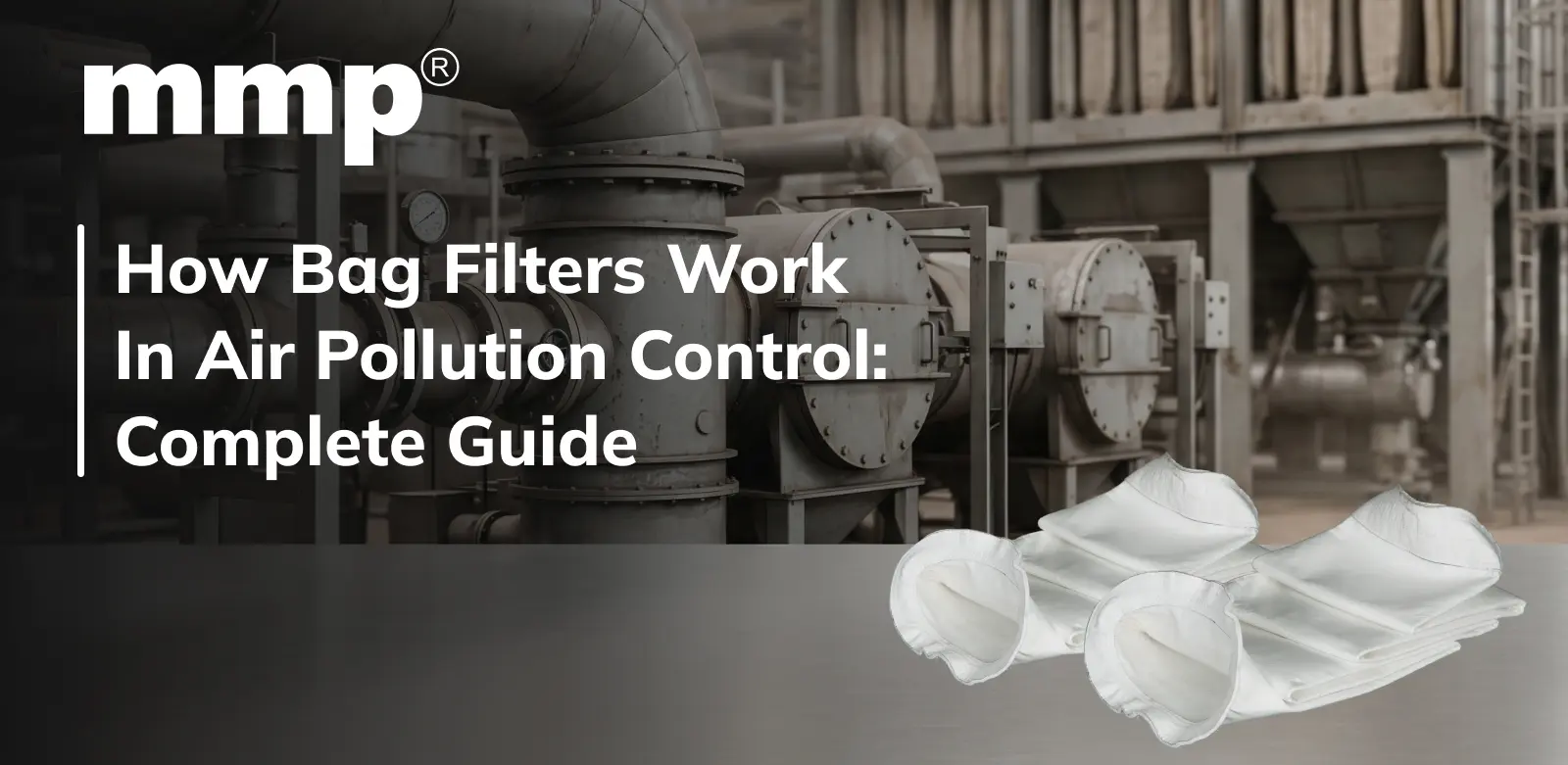
Industrial exhaust is not just “smoke.” It carries dust, fine particulate matter, and process-generated solids that can travel beyond the plant boundary if they are not captured properly. That is why a bag filter for air pollution control is still one of the most relied-on solutions in heavy industry. It delivers dry particulate capture at scale, and when it’s selected and maintained correctly, it keeps airflow steady while removing dust consistently. The principle is simple, but real performance depends on how well airflow distribution, cleaning method, bag material, sealing, and dust behavior are matched. When they’re aligned, you see predictable pressure drop and stable capture. When they aren’t, the same issues repeat: high differential pressure, dust carryover, and early bag failures. This guide explains bag filtration as a complete system so selection, maintenance, and replacement decisions stay practical and consistent.
A bag filter removes particulate by forcing dusty air through Filter bags while dust builds into a cake on the bag surface. Cleaning (pulse jet, reverse air, or shaker) removes excess cake at intervals so airflow stays stable. Performance depends most on bag material (temperature and chemistry), sealing integrity (no bypass), and cleaning tuning (not too weak and not too aggressive). These systems are common in cement and boiler operations in India, industrial clusters in the UAE, regulated sites in the UK/USA, and abrasive-duty plants in Australia.
Why Bag Filters Are Important for Air Pollution Control
Bag filters matter because they provide reliable dry particulate capture, which helps keep emissions and plant dust levels steady over long operating cycles.
A facility can run strong production and still struggle with emissions if particulate capture drifts. Dust that escapes a collector does not only create environmental exposure; it creates day-to-day operational headaches too. It settles inside ducts, coats surfaces, clogs louvers, and slowly reduces suction at pickup points. Over time, that settled dust becomes a secondary dust source, which increases recirculation and raises housekeeping load. This is why a bag filter system for dust control supports compliance and operational stability together. When the system operates within a stable pressure-drop band, pickup airflow stays dependable and dust is less likely to escape into work areas. Because baghouses are dry systems, they also avoid water handling and sludge disposal that often come with wet scrubbing. For heavy-duty sectors, this mix of stability and scalability is why baghouses remain a standard choice.
Operational reasons plants adopt baghouses
- Stable capture under changing loads: A properly designed system can handle high dust loads and mixed particle sizes, provided cleaning and media selection match the duty.
- Dry separation with simpler waste handling: Dust is collected as a dry solid in the hopper, which is usually easier to handle than wet sludge.
- Scalability for continuous duty: Baghouses can be sized for large exhaust volumes and long operating hours, which is why they are common in boilers and cement plants.
- Improved internal cleanliness: Better capture reduces dust recirculation inside the facility, which helps protect equipment and lowers housekeeping pressure.
What Are Filter Bags and How Do They Capture Dust?
Filter bags capture dust by holding particles on and within the fabric while cleaned air passes through, and a stable dust cake improves fine capture over time.
In a baghouse, pleated filter bags are the main filtration media. Dust-laden air is forced through the fabric; dust stays behind and cleaned air exits the collector. A core part of bag filtration is dust cake formation. Immediately after new bags are installed, very fine dust may pass more easily until a stable dust layer develops. Once the cake forms, fine capture typically improves because that dust layer becomes an extra filtering barrier. The trade-off is airflow resistance: a thicker cake increases pressure drop. That’s why cleaning is not optional. Cleaning cycles are meant to remove excess cake so pressure drop stays within a usable operating range, not to strip the bag completely clean every time. Under-cleaning causes chronic high ΔP and weak capture airflow. Over-cleaning increases flexing and fabric fatigue, which shortens bag life. This is the practical working logic behind a bag filter for dust collection.
How capture behaves in real operation
- Surface retention handles coarse dust first: Larger particles tend to collect on the bag surface and form the initial cake.
- Depth retention supports fine capture early: Before the cake stabilizes, fine particles can lodge within the media structure, especially with depth-type fabrics.
- Dust cake improves efficiency but raises ΔP: Cake helps fine capture, but resistance rises, so cake thickness must be controlled.
- Cleaning tuning drives long-term stability: Cleaning that’s too weak leads to blinding; cleaning that’s too aggressive leads to fabric fatigue.
Learn: What Is Bag Filter: Everything You Need to Know
Main Components of a Bag Filter System
A baghouse depends on matched components (bags, cages, tube sheet, seals, cleaning, hopper, monitoring), and a problem in one component often shows up as “bag failure.”
A baghouse runs reliably only when its parts work as a set. If airflow distribution is uneven, a small group of bags takes most of the load and blinds early while others remain underused. Sealing integrity at the tube sheet is critical because bypass leakage can happen even when differential pressure looks acceptable. Cleaning needs to be consistent, otherwise cake release becomes uneven and ΔP starts drifting. Hopper discharge must stay reliable too, because dust that doesn’t evacuate tends to re-entrain and causes unstable loading. Differential pressure monitoring is the simplest way to detect drift early and avoid emergency maintenance. In many plants, what gets blamed as “bag failure” is actually cage damage, sealing problems, or cleaning drift presenting as bag damage.
Main components
- Dust collector filter bag set: The filtration media that captures particulate; performance depends on material, fitment, and response to cleaning.
- Dust collector filter cages: Support the bag; rough welds, corrosion, or wrong diameter often create wear rings and pinholes.
- Tube sheet and seals: Separate dirty and clean air zones; sealing defects create bypass that looks like poor filtration even with new bags.
- Cleaning system: Pulse valves/headers or reverse-air mechanisms; inconsistency here creates uneven cake release and unstable ΔP.
- Hopper and discharge: Removes dust; poor evacuation increases re-entrainment and recurring high ΔP.
- Differential pressure monitoring: A trend indicator that helps distinguish blinding, leakage, and cleaning drift.
See Also: Filter Bags: A Quick Guide to Dust Filtration Solutions
Types of Bag Filters Used in Industrial Air Pollution Control
Bag filter “types” are mainly defined by cleaning method (pulse jet, reverse air, shaker), which determines how cake is removed and how much mechanical stress the bag sees.
Baghouse type is largely about cleaning method and airflow pattern because that decides dust cake release behavior and stress on the bags. Pulse jet systems use short bursts of compressed air to dislodge cake and are widely used because they support continuous operation in compact layouts. Reverse air baghouses clean by reversing airflow, which is generally gentler and often used in larger-volume setups. Shaker systems mechanically agitate bags and are used in certain legacy or specialized applications. The right type matters because different cleaning methods create different wear and fatigue patterns. From a maintenance view, pulse jet can shorten life if over-cleaned, while reverse air systems can drift if airflow distribution isn’t stable. Matching type to duty improves stability and reduces premature replacement.
Common types
- Pulse jet baghouse: Continuous duty, strong cleaning response, compact footprint; bags must tolerate frequent flexing.
- Reverse air baghouse: Gentler cleaning in larger systems; airflow distribution and compartment balance become critical.
- Shaker baghouse: Mechanical cleaning is used in certain designs; suitability depends on dust behavior and operating patterns.
- Industrial bag filter dust collector formats: Modular collectors for process and utility dust; stability depends on sizing and cleaning tuning.
Different Types of Filter Bag Materials (Polyester, Nomex, PTFE & More)
Bag material should be selected by continuous temperature, chemical exposure, moisture risk, and dust behavior because these decide life and pressure-drop stability.
Material selection is one of the strongest drivers of bag life and ΔP stability. Two bags can look similar but behave very differently if the fabric is mismatched to temperature, chemistry, or moisture conditions. Temperature is the first constraint because heat can weaken or degrade certain fibers. Chemical exposure is the second because acidic or alkaline environments can slowly attack materials. Moisture is often the most underestimated factor: condensation can turn “dry dust” into sticky dust that blinds quickly. Dust behavior then shapes the failure mode: abrasive dust increases wear, sticky dust increases blinding risk, and very fine dust increases the importance of sealing and stable cleaning response. Material selection works best when it’s tied to continuous operating conditions and dust behavior, not only to generic “strength.”
Common material families
- Polyester filter bags: Widely used for general dust collection with moderate temperatures and dry dust.
- Polypropylene filter bags: Used where moisture exposure and specific chemical resistance are priorities.
- Nomex filter bags: Applied where higher temperature stability is needed in hot dust duty.
- PTFE filter bags: Selected for chemical resistance and stable fine capture in aggressive environments.
- Fiberglass filter bags: Used for high-temperature duties, with attention to handling and brittleness in certain setups.
Read More: Bag Filter Types Explained: Uses, Benefits & Applications
How to Choose the Right Filter Bags for Your Industry
Choose bags by sequencing decisions: dust profile, temperature/chemistry, fitment/sealing, cleaning method stress, then airflow loading and maintenance discipline.
Selection becomes consistent when decisions follow a clear sequence. Start by defining the dust profile: abrasive, sticky, fine, fibrous, or mixed. Then lock continuous operating temperature and chemical exposure, because that removes unsuitable materials quickly. Next, confirm fitment and sealing, because bypass defeats filtration even with correct media. After that, match construction and durability expectations to the cleaning method, since pulse jet stress differs from reverse air stress. Finally, validate airflow loading versus filtration area. If a collector is undersized for dust load, even the best media will show chronic high ΔP and frequent replacements. Plants that document duty conditions and keep specifications consistent generally see far fewer repeating failures, even when ordering industrial bag filters across multiple replacement cycles.
Selection checklist:
- Define dust behavior clearly: Abrasive dust needs wear control; sticky dust needs dust-release performance; fine dust needs sealing and stable cake control.
- Confirm continuous temperature: Continuous conditions decide whether the fabric survives long cycles or degrades early.
- Assess chemistry and moisture risk: Condensation drives mudding and blinding; chemical exposure weakens fibers over time.
- Lock fitment and sealing: Wrong seals cause bypass leakage, which looks like low efficiency even with correct media.
- Match construction to cleaning method: Pulse jet needs bags that tolerate repeated flexing; reverse air and shaker have different stress profiles.
- Validate airflow loading and area: Undersized systems create chronic high ΔP and shorten life regardless of fabric quality.
Read More: Filter Bags Micron Rating Guide: How to Choose the Right Micron Size
Bag Filters Applications in Industrial Sectors
Bag filters are used where particulate generation is continuous or recurring and stable exhaust control is required, including boilers, cement, steel/foundries, pharma/chemicals, and fibrous dust sectors.
Baghouse filtration is used in sectors where dust generation is continuous or frequent and exhaust control must be stable. Boilers and power-related exhaust streams generate ash and fine particulate that must be captured consistently. Cement plants generate high dust loads during grinding, conveying, and packing, and humidity shifts can change dust behavior. Steel and foundry operations generate abrasive dust and metal fines, often with higher temperature exposure. Pharmaceutical and chemical units handle fine powders where containment and cleaner work environments are critical. Wood and paper operations produce fibrous dust that can mat and push ΔP up quickly if cleaning and media are mismatched. Across regions, the operating logic stays the same even when conditions vary by climate and industry mix.
Typical industrial applications:
- Boilers and power exhaust: Captures ash and fine particulate to prevent visible emissions and downstream fouling.
- Cement plants: Controls heavy loads at grinding, transfer, and packing, where dust behavior can change with humidity.
- Steel and foundries: Handles abrasive dust and metal fines where wear control and temperature compatibility matter.
- Pharma and chemicals: Controls fine powders where containment and predictable performance are critical.
- Wood, paper, textiles: Captures fibrous dust and lint that can mat; cleaning and media must be tuned to avoid rapid ΔP rise.
Maintenance Tips to Increase Filter Bag Life
Bag life improves when maintenance prevents the main failure drivers: cage abrasion, moisture-related blinding, hopper re-entrainment, and cleaning drift.
Most early failures trace back to a small set of causes: cage condition, moisture, hopper performance, and cleaning consistency. Rough or bent cages create abrasion points that become wear rings and pinholes. Hopper bridging or poor discharge causes dust re-entrainment, which destabilizes loading and increases ΔP. Cleaning drift, such as valve timing issues or inconsistent compressed air, leads to uneven cake release and either blinding or fabric fatigue. Moisture and condensation accelerate blinding because sticky dust doesn’t release well. A stable maintenance program watches ΔP trends and performs targeted inspections during planned shutdowns. When maintenance is disciplined, baghouses run in a predictable pressure band and bag life becomes repeatable across cycles.
Maintenance practices that extend bag life:
- Trend ΔP and cleaning frequency: A ΔP trend that steadily rises and doesn’t recover points to blinding, hopper issues, or cleaning drift and should trigger inspection early.
- Inspect cages proactively: Corroded, bent, or rough cages create wear rings; replacing cages prevents repeated pinhole failures in new bags.
- Keep hopper discharge reliable: If dust doesn’t leave the hopper, it re-enters airflow during cleaning and drives chronic high ΔP and unstable performance.
- Verify pulse system health: Valve timing, manifold condition, and compressed air quality directly affect cleaning consistency and dust release.
- Manage moisture and condensation risk: Dew point conditions turn dust sticky and accelerate blinding; insulation, leak control, and process stability reduce this risk.
- Check sealing during shutdowns: Tube sheet seals and installation quality decide bypass; small leaks can reduce effective capture noticeably.
When Should You Replace Filter Bags? (Signs & Replacement Guide)
Replace bags when ΔP remains high after correct cleaning, when clean-side dust indicates leakage, or when mechanical wear/blinding patterns show the bag can no longer perform reliably.
Replacement should be driven by performance signals and integrity checks, not only calendar intervals. A primary signal is differential pressure that stays elevated even when the cleaning system is functioning and tuned correctly. Another strong signal is dust in the clean plenum or downstream, which points to leakage or bag damage. Mechanical failures often show as pinholes or wear rings at consistent heights, and this is where a custom dust collector filter bag specification helps when the root cause is fitment mismatch, dust collector filter cages issues, or inlet abrasion zones. Blinding failures show as ΔP that climbs and doesn’t recover, often tied to sticky dust, moisture, or wrong media selection. Uneven compartment life suggests an airflow distribution imbalance. Planned replacements are preferred because they reduce installation errors and allow cage inspection and seal checks at the same time.
Common replacement signals:
- ΔP does not recover: If differential pressure stays elevated despite stable cleaning, bags may be blinded or dust may not be evacuating properly.
- Dust on clean side: Dust in the clean plenum indicates damaged bags or sealing defects at the tube sheet.
- Repeated wear patterns: Pinholes or wear rings at the same height often indicate cage roughness, misalignment, or inlet abrasion hotspots.
- Uneven compartment failures: One section failing early usually points to a distribution imbalance rather than bag quality alone.
- Over-cleaning indicators: High compressed air use and shortened bag life can indicate that cleaning is too aggressive, causing fabric fatigue.
Know More: Guide to Dust Collector Filter Bags
Why Choose mmp Filter for Custom Filter Bags
Supplier selection matters because bag filtration is repeat procurement and stable performance depends on consistent fitment, suitable materials, and repeat-order consistency.
Once selection and maintenance logic is clear, supplier choice is mainly about repeatability, fitment accuracy, and material range. Many facilities operate dust collection systems for air pollution control and also run liquid filtration lines for process fluids. Keeping dust-side products separate from liquid filter bags for liquid housings helps prevent specification confusion between air-side dust capture and liquid-side contaminant removal. For dust filtration, material choice and construction must align with temperature, dust behavior, and cleaning method. For liquid filtration, selection is driven by micron retention, fluid compatibility, and housing fitment. Plants with non-standard housings or collectors often require customization to control bypass and stabilize performance, which is where custom filter bags become relevant. Procurement teams typically value suppliers who can hold specifications steady across repeat orders and support application-matched designs rather than one-size substitutions.
What plants typically evaluate:
- Fitment accuracy and sealing reliability: Correct fitment prevents bypass, improves effective capture, and reduces clean-side dust issues.
- Repeat-order consistency: Consistent construction ensures performance does not drift between orders and replacement cycles.
- Material range for duty conditions: A range of materials helps match temperature, chemistry, and dust behavior without forced substitutions.
- Customization capability: Support for non-standard housings and collector geometry improves sealing and reduces repeat failures.
- Supplier readiness as a Filter Bags Manufacturer & Supplier: Long-term procurement requires stable supply, repeatable specs, and clear separation of dust-side and liquid-side categories.