Menu

Blog
Top Benefits of Using High-Quality Filtration Yarn in Manufacturing
Apr 28 2026
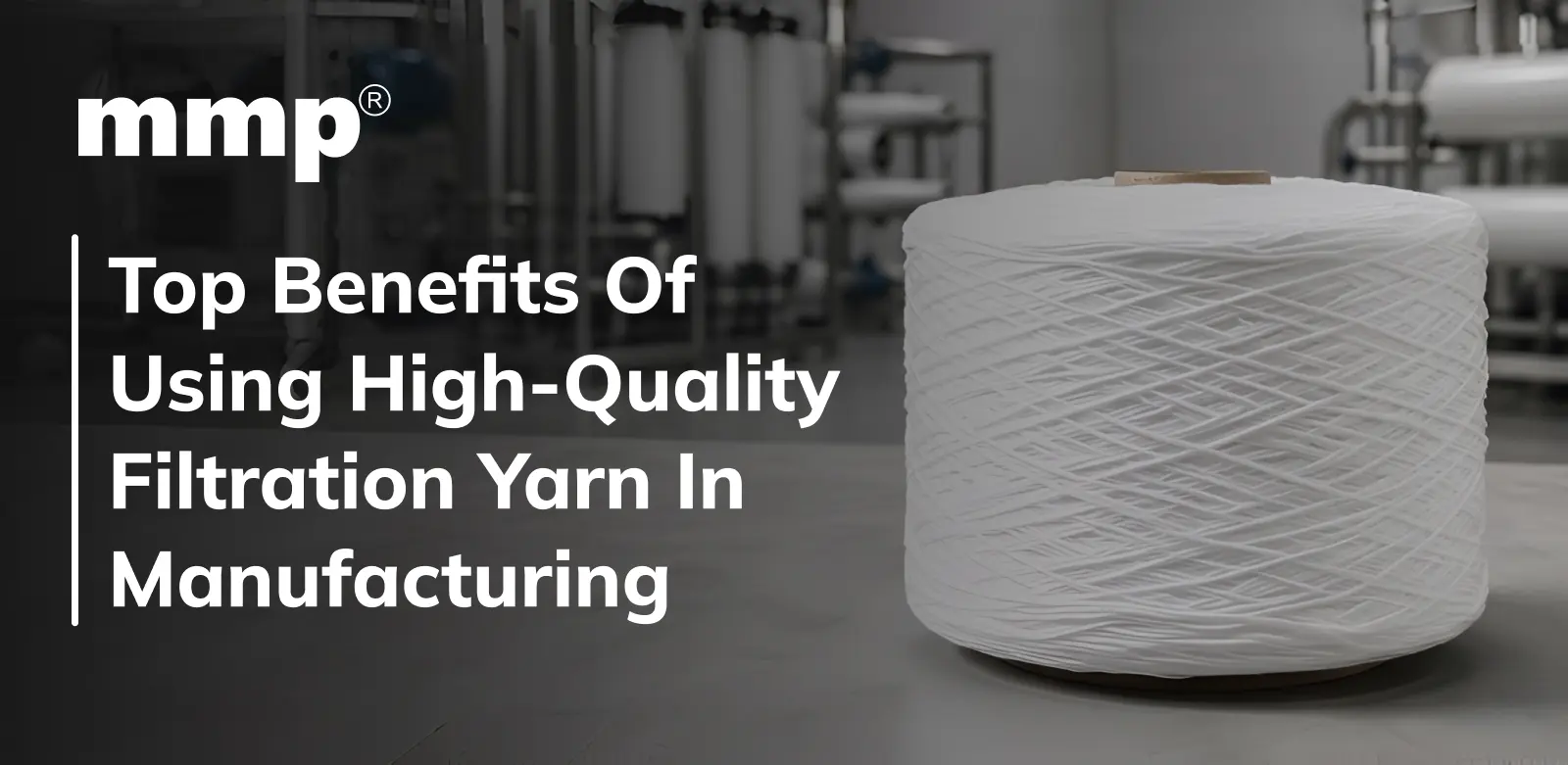
Nobody talks about yarn. Seriously. Walk into any industrial facility and ask the plant manager what their biggest filtration headache is. You will hear about pressure drops, membrane failures, sediment buildup, replacement costs climbing quarter after quarter with no obvious reason. What you will almost never hear is someone pointing at the wound cartridge in their housing and saying the yarn inside that thing is the problem.
But it is. More often than people want to admit.
Filtration yarn is the raw material at the heart of every wound filter cartridge. Specialised industrial thread, typically spun from polypropylene, cotton, polyester, or specialty blends, wound tightly around a core in a diamond or honeycomb pattern to create a depth filter. The global industrial filtration yarn market sat at USD 4.34 billion in 2023 and is heading toward USD 5.98 billion by 2030 at a 4.7% annual growth rate. Asia-Pacific alone accounts for 37% of global demand, with India right in the middle of that. That scale tells you something: this is not a niche material. It is foundational to how manufacturing stays clean, compliant, and operational.
The yarn inside your cartridge determines how well particles get trapped, how long the filter lasts before pressure becomes a problem, and whether your downstream equipment is genuinely protected or slowly accumulating damage while everything looks fine on the pressure gauge. Most buyers never think about this. Which is exactly why it keeps causing problems.
What Actually Goes Wrong When the Yarn Is Poor Quality
It does not announce itself. That is the frustrating part. Rounded, smooth yarn that has not been manufactured to proper tolerances rolls and shifts under operating pressure. That movement dismantles the honeycomb weave inside the cartridge. Bypass channels form. Unfiltered liquid starts moving through paths it was never supposed to reach. The filter looks completely normal from outside. Housing pressure might even read fine for a while longer.
Meanwhile, contamination is getting through. And the consequences show up somewhere else entirely: a pump needing replacement ahead of schedule, an RO membrane fouling faster than the model predicted, a quality test that comes back failed and nobody can immediately trace to the filtration stage because nobody looked there first.
A textile plant in Tirupur dealing with dye process water. A chemical facility in Ankleshwar handling aggressive solvents. A water treatment operation in Rajasthan working with high-TDS borewell water that loads up first-stage cartridges faster than expected through summer months when groundwater quality drops. Same story in all three places when you dig into it: yarn that could not hold its structure under real operating conditions.
See Also: PP Yarn: A Complete Guide to its Properties, Uses, and Benefits
This is not rare. It is a pattern that repeats across industries and geographies because yarn quality is the decision nobody scrutinises until after something downstream has already failed.
The Types of Filtration Yarn and What They Are Each Actually Good For
1. Polypropylene Yarn
PP is the dominant material in industrial filtration materials globally. Chemical resistance to most acids, alkalis, and organic solvents. No water absorption so pore structure does not change when wetted. Available across a wide denier and micron range. Cost-effective at industrial volumes. The reasons it became the default are legitimate.
What separates quality PP yarn from standard commodity PP yarn is not the polymer. It is the manufacturing process and what gets engineered out. mmp’s wound filter cartridges use a zero-foaming variant of polypropylene yarn specifically designed to eliminate foam formation during filtration. Chemical processing units in Vadodara, food production lines in Pune, water treatment plants along the coastal Gujarat industrial belt: in any of these environments where process fluid quality is contractual and export-facing, foam in the filtrate is a product failure. Not an inconvenience. Standard PP yarn suppliers do not engineer for this. The problem just gets passed downstream.
2. Liquid Filtration Yarns
Built specifically for water and process fluid applications. Two priorities above everything else.
First: low media migration. Fibres from the yarn should not shed into the filtrate during operation. Second: construction without surfactants, binders, or adhesives so nothing from the manufacturing process leaches into the fluid being filtered.
For pharmaceutical manufacturers in Hyderabad and Baddi, for RO pre-filtration systems across Gujarat's industrial estates where borewell groundwater carries heavy mineral loads, for bottling and food processing facilities in Pune and Delhi supplying regulated export markets in the UK and USA, liquid filtration yarns that fail on either of these criteria do not just underperform. They contaminate. And contamination from a filtration stage is the kind of quality failure that ends supplier relationships.
3. Anti-Microbial Polypropylene Filtration Yarn
This one deserves more attention than it typically gets in procurement conversations.
Anti-Microbial Polypropylene Filtration Yarn is high-purity PP yarn with FDA-approved antimicrobial additives embedded into the fibre during extrusion. Not applied afterward as a surface coating that degrades over service cycles. Embedded into the material itself, which means the protection is consistent from the first day of cartridge operation to the last.
Pharmaceutical plants in Ahmedabad working toward FDA compliance need this in their filter media and the documentation to prove it. Food and beverage facilities supplying UK and USA retail chains face international buyer audits where filter media antimicrobial specifications are part of the hygiene documentation package. Cosmetic manufacturers have contractual hygienic standards with brand owners that flow down to component specifications including filtration. All of these industries tend to discover they needed antimicrobial yarn documentation during an audit rather than before one. That is an avoidable situation.
mmp’s antimicrobial cartridge yarn is manufactured with FDA-approved additives, which is the specific credential these regulated markets require.
Cotton, Polyester, and Other Materials
Bleached cotton for potable water and food-grade applications where organic filter media is preferred. Polyester for processes running above 60 degrees Celsius where PP starts losing structural integrity. Both have legitimate use cases. Neither is the answer for general industrial filtration yarn requirements across the bulk of water treatment, chemical processing, and manufacturing applications.
DREF Yarn
Completely different construction for a completely different application. DREF yarn has a bulky, open fibre structure that delivers high air permeability and low pressure drop. This is what dust filtration actually needs.
Cement plants across Rajasthan where dust loads are continuous and relentless. Wood processing operations around Jodhpur. Grain handling facilities in Punjab. Textile mills in Surat where fibre dust is an operational constant every shift. In all of these environments, stable airflow and extended filter life are what matters, and standard twisted yarn simply cannot deliver equivalent performance in those conditions. mmp holds the highest production volume of DREF yarn in India, which means supply consistency and batch control that secondary producers of this yarn type cannot reliably match.
Learn More: DREF Spinning Yarn
What High-Quality Filtration Yarn Actually Delivers: The Real Benefits
Let me be direct here because this section often gets written as a list of vague positives that do not mean much without context.
Particle retention that holds across the service life, not just at installation.
A cartridge wound from high-quality filtration yarn maintains its pore gradient from outer coarse layers to tight inner layers throughout actual operating conditions. Pressure fluctuations, flow changes, variable inlet water quality: the structure holds. Cheap yarn deforms under these conditions. The gradient collapses. Particle retention drops while pressure differential still reads acceptable. The system looks operational. The downstream equipment or the product tells the real story weeks later.
Longer intervals between replacements and what that actually means financially.
For a processing plant in Surat running twenty filter housings across production lines, the difference between cartridge changes every five weeks with poor-quality yarn versus every ten to twelve weeks with properly specified filtration yarn for manufacturing is not a marginal saving. Add up product cost, labour time, and the downtime window for each change across a full year. The number is significant enough to justify the quality premium several times over. This calculation almost never gets done until someone is already frustrated with replacement frequency.
Downstream equipment lives longer.
When high-performance filtration yarn holds its structure and keeps contamination where it belongs, RO membranes last up to 30% longer per year. Pumps run cleaner. Heat exchangers in facilities from Nagpur to the GIDC estates in Ankleshwar do not accumulate abrasive sediment that grinds internal surfaces down over months of operation. One RO membrane replacement versus a year of properly specified wound cartridges is not a close cost comparison. Not even close.
The filter does not contaminate what it is filtering.
No adhesives, no binders, no surfactants in the manufacturing process means nothing from the yarn itself migrates into the filtrate. The filter removes contamination. It does not introduce its own.
In pharma and food processing this is a documented compliance requirement. In industrial water treatment where standards are less formalised, yarn that leaches into process water creates equipment and product problems that nobody connects to the filtration stage until someone looks specifically for it.
Consistent performance from one batch order to the next.
A pharmaceutical manufacturer in Hyderabad operating under a quality management system cannot have cartridges delivering 5 micron filtration from one batch and something closer to 8 micron from the next order. A food facility in Pune with documented quality parameters for filtered process water cannot tolerate unexplained variation between deliveries. Batch-to-batch reproducibility starts with tight control over yarn denier, twist, and diameter. It cannot be fixed downstream of inconsistent raw material. It has to be built into the yarn.
Water Filtration Versus Dust Filtration: They Are Not the Same Problem
This distinction matters and does not get enough attention in most filtration yarn conversations.
Filtration yarn for water filtration needs structural stability when continuously wetted, low media migration so nothing sheds into the liquid stream, and chemical compatibility with whatever specific fluid is being filtered. In Maharashtra where monsoon season pushes raw water turbidity through the roof for weeks at a stretch, first-stage wound cartridges take a load during that period that is two to three times the dry-season baseline. Yarn that cannot hold its structure through that variability ends up protecting nothing when protection is most needed.
Filtration yarn for dust filtration is a genuinely different material requirement. Air permeability comes first. Bulk structure matters more than tight inner gradient. The failure mode is pressure drop and airflow restriction rather than particle breakthrough into a liquid. DREF yarn exists because the dust application needs something that standard twisted yarn construction cannot deliver at equivalent performance levels.
Using liquid filtration yarns in a dust application, or dust-optimised yarn in a liquid system, does not just reduce performance. It makes the filter work against the process it is supposed to support.
Choosing the Right Yarn: What the Decision Actually Comes Down To
Standard liquid filtration in industrial conditions: zero-foaming polypropylene yarn at the appropriate denier and micron rating from a manufacturer who controls the full production chain.
Sterile or hygiene-critical liquid applications in pharma, food, cosmetics, or healthcare: Anti-Microbial Polypropylene Filtration Yarn with documented FDA-approved additives and paperwork that holds up in a compliance audit.
Heavy industrial dust filtration: high-bulk DREF yarn with verified air permeability specifications from a supplier with genuine production volume in that specific yarn type.
High-temperature processes above 60 degrees: polyester or specialty blends, application-specific.
One practical specification worth adding to any supplier evaluation: does the filtration yarn supplier manufacture the yarn and wind the cartridges in the same facility under the same quality system? When yarn production and cartridge winding are controlled by different companies, consistency across the full component chain is harder to document and harder to guarantee. When it is a single integrated operation, every variable sits inside one controlled environment and one quality audit trail.
Why mmp Is the Manufacturing Partner Worth Talking To
mmp Filtration has been making filter yarn and wound filter cartridges since 1994. Ahmedabad-based, supplying manufacturers and treatment facilities in the USA, UK, UAE, Australia, and across India. PP yarn, zero-foaming PP yarn, DREF yarn, and antimicrobial PP yarn produced in-house alongside the finished cartridges wound from them. Everything under one roof, one quality system, one supply chain.
Highest DREF yarn production volume in India. First company in India to achieve NSF certification for filter cartridges. Antimicrobial yarn with FDA-approved additives. These are documented specifics, not general quality positioning.
For operations across Gujarat, Maharashtra, Rajasthan, Telangana, Karnataka, and internationally, mmp’s direct supply model means the yarn your cartridge is built from does not drift between orders. Consistent industrial filtration yarn produces consistent cartridges produces consistent filtration outcomes. That chain of consistency is the whole point.
Conclusion
High-quality filtration yarn delivers particle retention that holds across the full service life, longer replacement intervals, genuine downstream equipment protection, zero contamination risk from the filter media, and the batch reproducibility that quality-managed manufacturing depends on. mmp Filtration has operated that way since 1994. The production credentials are specific and documented. The supply chain is direct. The consistency is built into the manufacturing process rather than promised in the sales conversation.Good filtration starts with good yarn. Every downstream outcome either benefits from that or pays for the alternative.