Menu

Blog
Buying Water Filter Cartridges Online: A Procurement Guide for Businesses
Jun 08 2026
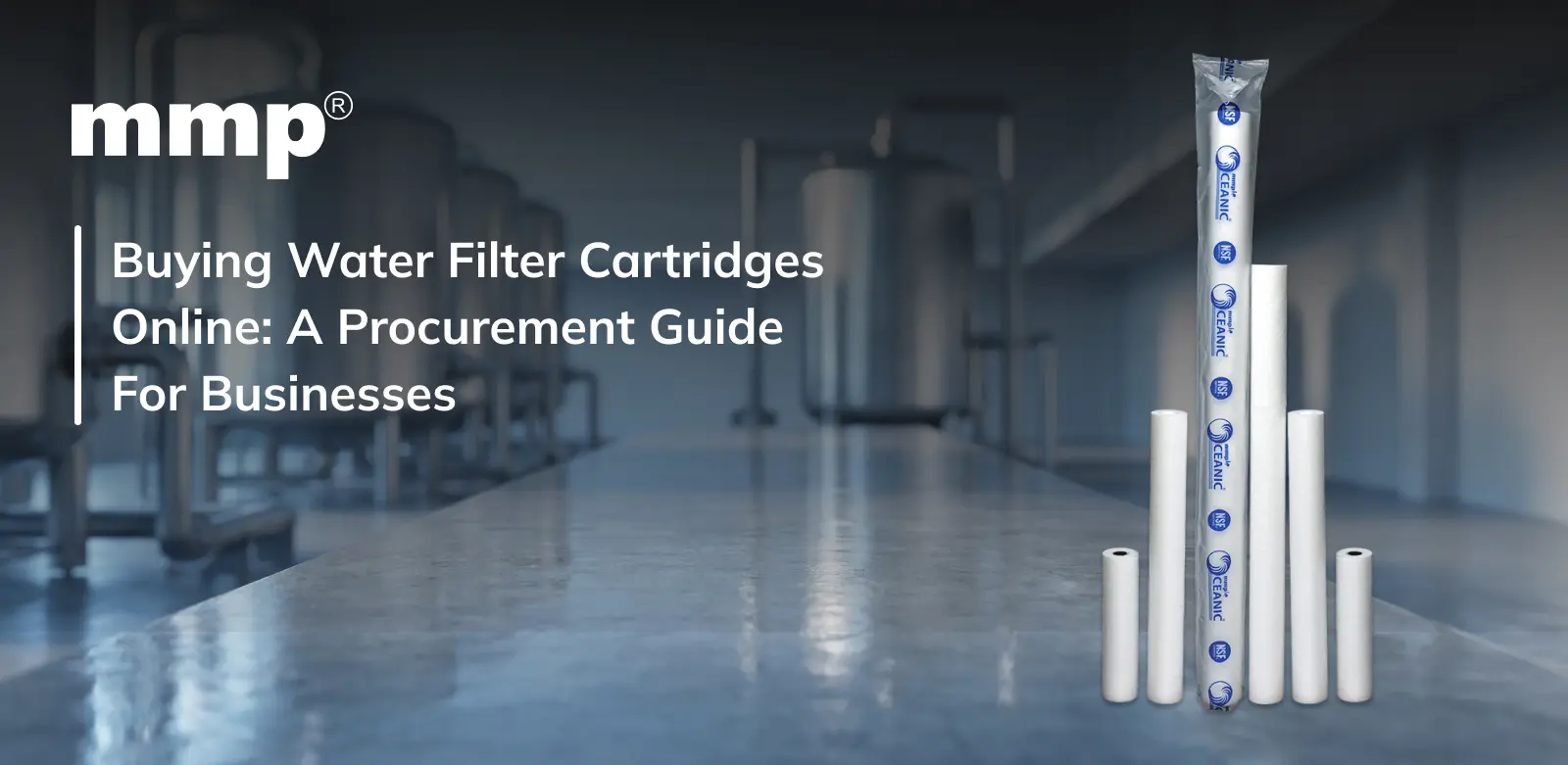
For most businesses, clean water isn't optional. It protects machines in manufacturing, keeps food and drink safe, and helps pharma and healthcare stay compliant. But many teams buy Water Filter Cartridges like any other catalog item. The cost of that shows up later as clogging, pressure problems, and unplanned downtime.
Buying online is a good option. You just need to lock the specification before you order. This Water Filter Cartridge Buying Guide is for procurement and operations teams who want steady performance and fewer surprises.
The short version: to Buy Water Filter Cartridges Online the right way, do three things in order.
1. Define the real problem (sediment, pressure drop, membrane fouling, or unstable flow).
2. Lock four basics: housing fit, peak flow, media type, and micron rating.
3. Check the paperwork (spec sheet, materials, batch consistency) before a bulk order.
The Hidden Cost of Choosing the Wrong Water Filter Cartridge
The wrong cartridge rarely fails on day one. It costs you slowly, even when the price looks low.
A simple example shows why. Say you have a 10-inch housing fitted with a 1-micron cartridge (a very fine filter). But the incoming water is full of heavy 50-micron sand, which is much larger. The fine cartridge blocks almost at once. Pressure climbs, flow drops, and the team swaps the cartridge. The new one blocks too. Eventually someone blames the water, when the real issue is the wrong micron rating.
Here is where the cost actually lands:
- Short cartridge life. A filter that should last 6 to 12 months gets replaced in 3 to 4 weeks
- Downtime. Flow drops at peak demand and a line stops mid-shift for an unplanned swap.
- Damage downstream. A weak first filter lets small particles through, so an RO (reverse osmosis) membrane built for two years can fail in eight months.
- Quality risk. Cloudy water reaches the final product. In food, pharma, and water treatment, that gets expensive fast.
Learn More: What Are Water Cartridge Filters? All Types, Sizes & Applications
Before You Buy Online: Define the Problem You're Trying to Solve
Online buying goes wrong when the request is just a size. "We need a 10-inch cartridge" tells a supplier almost nothing. A clear brief tells them everything.
Compare these two:
- Weak: "10-inch cartridge."
- Strong: "10-inch cartridge handling 25 m³/hr of borewell water that rises to 30 NTU in monsoon, protecting an RO bank." (NTU is a measure of how cloudy the water is. Higher means dirtier.)
To write a strong brief, note four things:
- What changed: For example, pressure rose from 0.3 to 1.2 bar in two weeks, or flow fell 20%.
- Where it shows up: At the inlet gauge, inside the housing, or on a pump or membrane further down the line.
- When it gets worse: Peak production, monsoon, or right after a tank clean.
- What feeds the system: Municipal supply, borewell, recycled water, or a mix.
The same housing needs very different cartridges depending on the water. Borewell water rising to 30 NTU is a different job from a steady 2 NTU municipal supply.
8 Technical Specifications Buyers Should Never Ignore
Most "quality problems" are really specification misses. Pin these eight points down on a one-page sheet for each filtration stage, and reordering becomes simple.
| NO. | Specification | What to Confirm | Typical Figures |
|---|---|---|---|
| 1 | Size and fitment | Length, diameter, end-cap style, seal type | 10"/20"/30"/40" lengths; DOE or 222/226 end caps |
| 2 | Micron rating | What you're protecting, not just how fine | 20 to 50 µm for coarse sediment; 5 µm for an RO pre-filter; 1 µm or below for polishing |
| 3 | Media type | Depth vs surface, and how much dirt it holds | Melt-blown depth media (also sold as a spun filter) for graded sediment; pleated surface media for high dirt-holding |
| 4 | Flow requirement | Peak flow, not the average | Size for the busiest hour, not the daily mean |
| 5 | Allowable ΔP | When pressure drop triggers a change | Replace at about 1.0 to 1.5 bar (15 to 22 psi) rise over the clean reading |
| 6 | Temperature | The steady range, not the odd spike | Polypropylene handles about 60 °C continuous |
| 7 | Chemical exposure | Cleaning chemicals, additives, disinfectants | Check the media works with your CIP chemicals and chlorine |
| 8 | Supply consistency | The same spec on every batch | Same media weight, micron, and seal each reorder |
A quick note on two terms above. DOE means "double open end," a cartridge open at both ends. 222 and 226 are bayonet-style fittings that lock in. A cartridge with the wrong end type will leak past the filter even when new.
Read More: Water Filter Cartridges for Industrial and Home Use
Questions Procurement Teams Should Ask Before Ordering Online
Ask the right questions once, write down the answers, and reuse them as a template.
- What is the water source, and what contaminants usually appear at this site?
- What is the peak flow (m³/hr) through the housing?
- What triggers a replacement today: a date, a pressure reading, or a complaint?
- Is this stage protecting something sensitive, like an RO membrane, boiler feed, or spray nozzle?
- Would two stages (a 25 µm coarse filter before a 5 µm fine filter) extend the life?
- Is there a written spec for this line, or is every order a fresh guess?
There is a common trap here. Two sites order the same cartridge. One runs borewell water rising to 30 NTU, the other a calm 2 NTU supply. The same part clogs in weeks at one site and lasts months at the other. The supplier gets blamed, but the water was different all along.
Buying Water Filter Cartridges Online? Avoid These Costly Mistakes
Online buying isn't the problem. Ordering without a confirmed spec is. Done well, it cuts variation. Done badly, it adds more.
| Mistake | What it Looks Like in Practice |
|---|---|
| Going too fine, too early | A 1 µm cartridge on raw 40 µm sediment blocks within days |
| Ignoring fitment | A DOE cartridge in a 226 housing leaks past the filter, even when new |
| Swapping media casually | Replacing depth melt-blown with pleated changes how pressure builds |
| Ordering by "looks similar" | Two near-identical photos, two different micron ratings |
| Not standardizing parts | Five sites, five slightly different part numbers, one messy stockroom |
How to Match the Right Cartridge to Your Industry
Industries don't need "better" cartridges. They need a cartridge matched to their water, their peak flow, and what sits downstream.
- Hospitality and commercial. Commercial Water Filter Cartridges, such as a 5 µm sediment filter on a set replacement cycle, since guests notice downtime at once.
- Manufacturing and utilities. Industrial Water Filter Cartridges, like a 25 to 50 µm string-wound filter to remove rust and scale before it reaches valves and nozzles.
- Food and beverage. Two stages (coarse, then 1 to 5 µm) for steady clarity and clean process water.
- Pharma and healthcare. Tight, documented micron control with tested, repeatable media.
- Municipal and plant utilities. Water Filter Cartridges for Water Treatment Plants, using several stages because inlet cloudiness moves around a lot.
The point is the same across all of them. Match the cartridge to the water, not to the catalog. Sites that choose by downstream risk and peak flow almost always get longer life and fewer surprises than those that choose by price or habit.
How Bulk Online Purchasing Can Reduce Procurement Challenges
Buying bulk water filter cartridges Online helps only when the spec is fixed and you know your usage. Without that, you just buy a mistake in larger numbers and end up with dead stock.
Done right, bulk ordering does four useful things:
- Cuts emergency buying and mid-shift downtime.
- Smooths out the freight costs of many small orders.
- Keeps one steady spec in use.
- Tidies the stockroom.
Before you commit to volume, get two numbers clear: your usual replacement interval (say, every 8 weeks) and your peak-season load. Skip that, and you might stock a full year of cartridges yet still run short when monsoon triples your changeout rate.
What Procurement Teams Should Verify Before Buying Online
Most online-buying failures come down to a fitment mismatch or the wrong media, not a bad supplier. Check these before checkout:
- Housing size and seal type (DOE vs 222/226), so the cartridge can't leak past
- Media matched to the job: coarse sediment, fine polishing, or equipment protection
- Filter area sized for peak flow, not average
- A realistic replacement trigger set (for example, change at 1.2 bar rise)
- Part number and spec matched to your own records for that line
- A spec sheet and batch-consistency note ready for repeat orders
How mmp Supports Businesses with Reliable Filtration Solutions
A supplier proves itself on the second order, not the first. The real test is whether the spec stays the same from batch to batch, so you aren't troubleshooting a "new" cartridge every time you reorder.
That is the gap mmp filtration is built to close. As a Water Filter Cartridge Manufacturer, mmp makes the full chain in-house, from PP yarn and PP cores to the winding machines and the finished cartridge, all under one roof. That control is what keeps each batch matching the last.
A few things make mmp a dependable Water Filter Cartridge Supplier for Industries:
- In-house manufacturing. Owning the whole process means tighter control over media weight, micron, and seal. That is where batch consistency comes from.
- A long track record. mmp has supplied NSF-certified cartridges worldwide since 1994, so the consistency is proven, not promised.
- A wide range. Melt-blown, pleated, spun filter cartridge, string-wound, and carbon options, with micron ratings from 0.5 to 100, plus custom length, diameter, end caps, and materials. One supplier can cover every stage across your sites.
The most common quality complaint in the field is a replacement that fits the housing but uses a slightly different media weight or seal, so the pressure builds differently within weeks. In-house control over the whole product is what prevents that.
Whichever supplier you pick, ask for the same proof: a spec sheet for the exact part, written confirmation of batch-to-batch consistency, a recommended replacement point, and assurance that the same spec holds across all your sites.
Creating a Cost-Effective Long-Term Filtration Strategy
A cost-effective program isn't about the cheapest unit. It's about choosing Water Filtration Cartridges that fit the job and buying them less often, with fewer problems downstream.
The most stable programs share four habits:
- Use stages when the water is dirty. A 25 µm coarse filter protects and extends a 5 µm fine filter.
- Replace on trend, not on the calendar. Watch the pressure and change at a set point before flow drops.
- Standardize parts by line. Any buyer can reorder the exact same part.
- Review failures each quarter. Fix the cause, whether a wrong micron or an undersized housing, instead of just replacing faster.
Online buying helps here when it supports steady ordering and clear specs. It stops helping the moment it invites random substitutions.
Conclusion
Buying cartridges online works well when the spec is clear and repeatable. The real risks are wrong micron guesses, fitment mismatches, and no standard across sites. The fix is simple: define the problem, lock the specs, check fitment and purpose, then standardize repeat orders. Do that consistently, and replacement stops being a disruption. It becomes a planned routine, with lower cost and better-protected equipment downstream.