Menu

Blog
Benefits of Using Liquid Bag Filters in Industrial Systems
Mar 21 2026
Ask any plant engineer about the last time process fluid quality caused problems, and you'll hear a familiar story. Output slipped. The equipment started wearing faster. The maintenance bill crept up. For weeks, nobody could explain why.
Filtration is almost always somewhere in that chain. Not always the system design itself, but the specific equipment chosen for it. Liquid bag filters have been doing the heavy work in industrial plants for decades, yet procurement conversations still default to cartridges without much scrutiny.
The decision matters more than most procurement teams realise. Choose the wrong bag type, wrong micron rating, or wrong material, and you're either replacing bags far too often or letting contaminants through to damage downstream equipment. Neither shows up immediately on a spec sheet.
This blog covers what industrial liquid bag filters actually do, where they outperform alternatives, how specific industries use them, and what to check before you buy. If you're evaluating liquid bag filtration systems for your plant or reviewing your current setup, this is the practical context you need.
What Are Liquid Bag Filters?
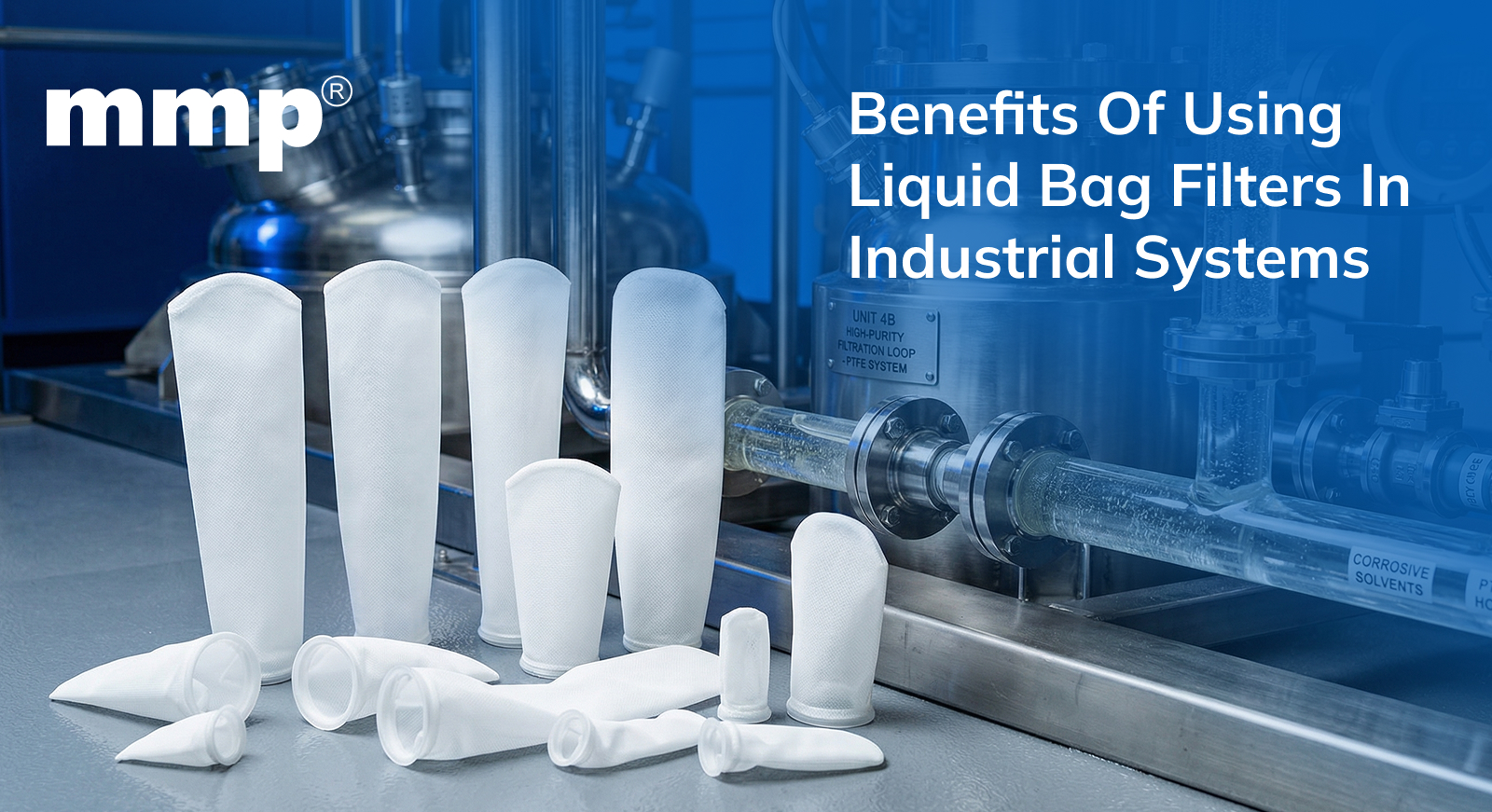
A bag filter for liquid filtration is a filter bag installed inside a pressurised housing. Liquid enters, passes through the bag material, contaminants get trapped, and clean fluid exits through the outlet. A perforated basket holds the bag in shape so it doesn't collapse under operating pressure.
The reason it works across so many industrial environments is what you can run through it. Water, chemicals, oils, coolants, syrups, solvents — liquid filtration bags handle a wide range of fluids without needing a separate setup for each one. The micron range stretches from 1 to 200, covering everything from fine polishing to coarse pre-filtration, depending on where the bag sits in the system.
One thing that surprises engineers switching from cartridge systems is how fast bag replacement actually is. Minutes, not hours. That alone changes maintenance scheduling.
Key Takeaways
- A bag filter for liquid filtration traps particles either on the bag surface or within the media depth depending on bag type and micron rating, and works across water, chemicals, oils, coolants, and syrups
- The 1 to 200 micron range covers both fine polishing and coarse pre-filtration duties within the same bag technology depending on where it sits in the system
- Bag replacement takes minutes which is a meaningful operational difference from cartridge systems, especially compounded across a full year of continuous operation
Learn More: Liquid Filter Bags: Types, Applications, and Benefits
How Liquid Bag Filtration Systems Work
Most liquid bag filtration systems operate on an inside-out flow pattern. Liquid enters the housing, moves from the inside of the bag outward, contaminants stay trapped inside, and clean filtrate exits through the outlet. This keeps captured particles contained and makes bag removal cleaner.
Standard bag sizes run from Size 1 through Size 4 for most industrial applications, with custom dimensions available beyond that. A bag that doesn't fit properly won't seal at the ring and liquid will bypass around it entirely, making the filtration step pointless.
The perforated basket inside the housing prevents the bag from deforming under pressure. That's what allows these systems to handle the high flow rates that make them economical for large-volume operations.
Key Takeaways
- Liquid bag filtration systems use an inside-out flow pattern that keeps contaminants trapped inside the bag while clean filtrate exits through the housing, making bag removal cleaner and faster
- Bag sizing is critical because a poorly fitted bag bypasses at the seal making filtration ineffective regardless of the micron rating specified
- The perforated basket prevents bag collapse under pressure which is what enables high flow rates and keeps these systems economical for large-volume liquid processing
Key Benefits of Liquid Bag Filters in Industrial Applications
The benefits of liquid bag filters aren't about one standout feature. Several practical advantages compound together in a way that shows up clearly in operating costs over time.
Dirt-holding capacity is the big one. High quality liquid bag filters hold substantially more contamination before needing replacement compared to cartridge alternatives. Fewer bag changes means less downtime and less disruption to production schedules.
Pressure drop is the quiet one. Consistently low differential pressure means pumps aren't working harder than necessary. Energy costs stay predictable and flow rates hold steady.
Liquid bag filters for industrial applications give you material flexibility most filter formats don't. Polypropylene for acids and alkalis. Polyester for oil-based fluids and higher temperatures. PTFE for extreme conditions where standard materials fail. Nylon mesh where the bag gets cleaned and reused. Industrial liquid bag filters can be matched to almost any process fluid without compromise.
At volume, high efficiency pleated filter bags consistently cost less to run than cartridge systems. Higher dirt-holding capacity, less frequent replacement, and simpler maintenance. The cost gap widens the longer the system runs.
MMP Filters manufactures the full range of liquid filtration bags across all material types and micron ratings, with standard and custom configurations suited to these exact industrial requirements.
Key Takeaways
- High-quality liquid bag filters hold significantly more contamination than cartridge filters before needing replacement, directly cutting how often equipment needs to come offline for maintenance
- Material options across polypropylene, polyester, PTFE, and nylon mean industrial liquid bag filters can be matched to almost any process fluid without design compromise
- High efficiency liquid bag filters deliver lower total operating cost than cartridge alternatives, and the savings compound over time through reductions in consumables, labour, and pump energy
Read Also: Guide to Dust Collector Filter Bags
Why Industries Prefer Bag Filters Over Cartridge Filters
This comparison comes up in almost every industrial procurement conversation.For high-volume continuous processing, liquid bag filters have a consistent edge.
Cartridge filters do some things well. Precise filtration at lower flow rates and absolute-rated performance for sensitive applications. But in high-contamination, high-flow conditions they clog fast, cost more per unit, and generate more waste relative to the volume processed.
Industrial liquid filtration bag filters are built for volume. More contamination, longer intervals between changes, lower consumable cost. For water treatment, chemical lines, food production, and oil handling where serious quantities of liquid move around the clock, bag systems win on economics.
Worth noting — the two aren't competing options so much as complementary ones. Many well-run plants use bag filters for bulk contamination removal at the primary stage and bring cartridges in downstream for final polishing.
Key Takeaways
- Industrial liquid filtration bag filters hold more dirt, last longer between changes, and cost less per volume processed than cartridge filters in high-volume, high-contamination applications
- Bag filters and cartridge filters are more often complementary than competing, with many plants running bags at the primary stage and cartridges downstream for polishing
- For water treatment, chemical processing, food production, and oil handling where continuous high-volume operation is the norm, liquid bag filters consistently deliver better operating economics
Liquid Bag Filters for Water Treatment Plants
Water treatment is one of the highest-volume use cases for liquid bag filters for water treatment plants. Incoming industrial water carries suspended solids, sediment, and biological material that needs pulling out before moving further through the treatment process or into industrial reuse.
Liquid bag filters for water treatment sit at that primary separation stage reliably. A 5 micron water filter bag is a common specification here — fine enough to catch particles coarser bags would miss without restricting flow rates in continuous operation.
Plants don't stop running. Every filter change means stopping the process or switching to bypass. Those interruptions compound fast across a year. Bags that run longer before replacement keep things moving.
For reuse applications with strict output clarity standards, a two-stage approach works well. Coarser bags handling the primary load, finer bags polishing the output downstream. More economical than running fine filtration at the front where contamination loads are heaviest.
Key Takeaways
- Liquid bag filters for water treatment plants handle primary removal of suspended solids, sediment, and biological material before water moves to downstream treatment stages or industrial reuse
- A 5 micron water filter bag is frequently specified in water treatment because it delivers fine particle control without restricting flow rates in continuously running systems
- Two-stage bag setups using coarser primary bags followed by fine polishing bags meet strict output clarity requirements more economically than running fine filtration at the primary stage
Read More: Filter Bags: A Quick Guide to Dust Filtration Solutions
Liquid Bag Filters for the Chemical Industry
Chemical processing is harder on filtration equipment than most environments. Aggressive solvents, strong acids, alkalis, high pressures, elevated temperatures — a lot of what works elsewhere simply doesn't survive here.
Liquid bag filters for chemical industry applications get specified with material compatibility as the starting point. Polypropylene covers the broad acid and alkali range and is the default for most general chemical processing. For oil-based or solvent-based fluids at higher temperatures, polyester's mechanical strength is the practical choice. For extreme conditions combining high heat with aggressive chemistry, PTFE holds up where others fail.
Construction method matters too. Fully welded bags made with ultrasonic welding have no stitch holes. In standard bags those holes can become bypass points as pressure builds. In chemical processing where product stream contamination is a serious problem, specifying welded construction isn't overcautious. It's correct.
Industrial liquid bag filters in chemical plants often serve double duty — pulling process impurities out during manufacturing while simultaneously protecting pumps, heat exchangers, and reactors from the gradual particulate damage that accumulates quietly over time.
mmp Filters manufactures polypropylene, polyester, PTFE, and nylon liquid bag filters for chemical industry applications, with custom configurations available for non-standard housing setups.
Key Takeaways
- Material compatibility drives selection for liquid bag filters for chemical industry applications because aggressive chemistry, elevated temperatures, and high pressures eliminate many standard filtration materials
- Fully welded bag construction eliminates stitch holes that become bypass points under pressure and is the right specification for chemical processes where product stream contamination cannot be tolerated
- Industrial liquid bag filters in chemical plants often serve double duty by removing process impurities during manufacturing and protecting downstream equipment from gradual particulate damage
Liquid Bag Filters for Food Processing
Filtration in food processing has two layers of requirement. The technical ones and the compliance ones sitting on top. Liquid bag filters for food processing have to perform reliably within food-grade material standards that leave no room for shortcuts.
FDA-compliant materials are the baseline. Bags go into production individually packaged to prevent contamination before installation. Construction minimises fibre shedding because loose fibres in food-grade filtrate are a regulatory problem, not just a quality concern.
Calendared felt reduces fibre loss versus standard felt. Silicone-free sealing is available where silicone contamination must be avoided. Stainless steel housing compatibility supports sanitary installation requirements.
Applications are broader than people assume — syrups, edible oils, dairy products, beverages, and process water. A 5 micron water filter bag comes up regularly in food processing lines for process water filtration running alongside main production fluid filtration.
The filter bag manufacturing company on the supply end needs to provide raw material traceability and batch-to-batch consistency. In food-grade supply chains these are requirements, not optional extras.
Key Takeaways
- Liquid bag filters for food processing require FDA-compliant construction, individual pre-installation packaging, and media designed to minimise fibre shedding which is a compliance issue not just a quality one
- A 5 micron water filter bag gets regular use in food processing for process water filtration running alongside main production fluid filtration
- The filter bag manufacturing company supplying food operations must provide raw material traceability and batch consistency documentation because these are regulatory requirements, not optional extras
Cost Efficiency and Maintenance Advantages of Liquid Bag Filtration Systems
The cost argument for liquid bag filtration systems is straightforward once you look at it per year rather than per unit.
Bag changes take minutes. No special tools, no extended procedures. Compared to cartridge changeouts, the difference in labour time across twelve months is significant even if it doesn't show on a spec sheet.
Extended-life bags take this further. Progressive-density media captures particles through the full depth of the material rather than loading up on the surface. In heavy contamination applications these bags run up to five times longer than conventional felt bags before replacing. Five times fewer interruptions. Five times fewer bags ordered.
High-capacity designs increase filtration surface area per bag, slowing pressure build-up and extending intervals before the bag is spent. Worth evaluating seriously if change frequency is currently creating operational disruption.
High efficiency liquid bag filters reduce total operating cost through lower consumable spend, less maintenance labour, fewer process interruptions, and reduced pump load from consistently low differential pressure. None are large individually. Combined over a year they represent a meaningful saving.
Key Takeaways
- Bag changes in liquid bag filtration systems take minutes for a trained operator and that speed compounds into significant cumulative savings in maintenance labour and process downtime across a full year
- Extended-life bags with progressive-density media can run up to five times longer than conventional felt bags in heavy contamination applications, cutting consumable spend and maintenance frequency substantially
- High efficiency liquid bag filters reduce total operating cost through lower consumable spend, less maintenance labour, fewer interruptions, and reduced pump load from consistently low differential pressure
How to Select a Reliable Liquid Bag Filters Manufacturer
Product consistency is where the gap between liquid bag filters manufacturers shows up in practice. The first order often looks fine. It's repeat orders at volume where specification drift and material substitutions start causing performance problems that are difficult to diagnose at plant level.
Manufacturing experience in your specific industry matters more than general filtration capability. A supplier who understands chemical processing requirements selects differently than one who doesn't. Same with food-grade. Same with pharmaceutical.
Certifications and traceability documentation are non-negotiable for regulated applications. Ask for them before placing an order. If a supplier makes that difficult, that tells you something useful.
A liquid bag filters manufacturer who can adjust micron rating, material, dimensions, and sealing type as your requirements evolve is a more valuable long-term supplier than one limited to standard configurations.
mmp Filters has been producing high quality liquid bag filters since 1994. Over 30 years of manufacturing for clients across pharma, chemical, water treatment, food and beverage, oil and gas, textile, and power generation. Standard and custom configurations, bulk supply capacity, and export to the USA, UK, UAE, and Australia.
Key Takeaways
- Industry-specific experience matters when selecting a liquid bag filters manufacturer because application knowledge directly affects whether the product recommended suits your actual process conditions
- Certification and traceability documentation should be confirmed before any order, particularly for food-grade and pharmaceutical applications where these are supply chain requirements not optional extras
- Consistency across repeat orders at volume is where the real difference between liquid bag filters manufacturers shows up and should be weighted heavily when evaluating supplier options
Buying and Sourcing: What to Know Before You Order
When you buy liquid bag filters for an industrial operation, unit price tends to dominate the conversation early. It shouldn't.
Confirm your actual micron rating requirement from process conditions, not from what was used previously or listed as standard. Verify material compatibility for your specific fluid, especially in chemical or high-temperature applications where the wrong material fails faster than expected. Check bag size against your housing properly because a size mismatch causes bypass regardless of everything else.
Think about configuration honestly. Standard felt bags suit many applications. But fully welded, extended-life, and high-capacity options often cost less over twelve months even when the unit price is higher. That calculation is worth doing before ordering.
Working with a dust collector filter bag supplier who manufactures directly gives you better base pricing, more consistent specifications on repeat orders, and genuine technical support when something needs to change. Any custom requirements around dimensions, chemical resistance, or compliance documentation should come up before the order, not after delivery.
Key Takeaways
- When you buy liquid bag filters at industrial scale, material compatibility, housing fitment, and configuration type affect total operating cost more significantly than unit purchase price does
- Working with a wholesale liquid bag filters supplier who manufactures directly provides better pricing, consistent specifications on repeat orders, and genuine technical support as process requirements change
- Custom requirements for dimensions, chemical resistance, or compliance documentation must be confirmed with the manufacturer before ordering to avoid specification mismatches that cause performance problems post-installation
Conclusion
A filter bag is a consumable. The decision behind which one to specify isn't. Get it right, and the system runs, costs stay predictable, and equipment lasts. Get it wrong and you spend months troubleshooting problems that trace back to a procurement decision nobody thought hard enough about.
Liquid bag filters at industrial scale mean high dirt-holding capacity, stable pressure, material flexibility, and operating economics that hold up against cartridge alternatives when you run the numbers properly. For plants processing large liquid volumes continuously, the case is consistent.
mmp Filters has manufactured the full range of liquid filtration bags since 1994 — standard, fully welded, extended-life, high-capacity, food-grade, and custom configurations. Over three decades of industrial supply experience across global markets. The right bag exists for your application. The job is making sure you specify it correctly.